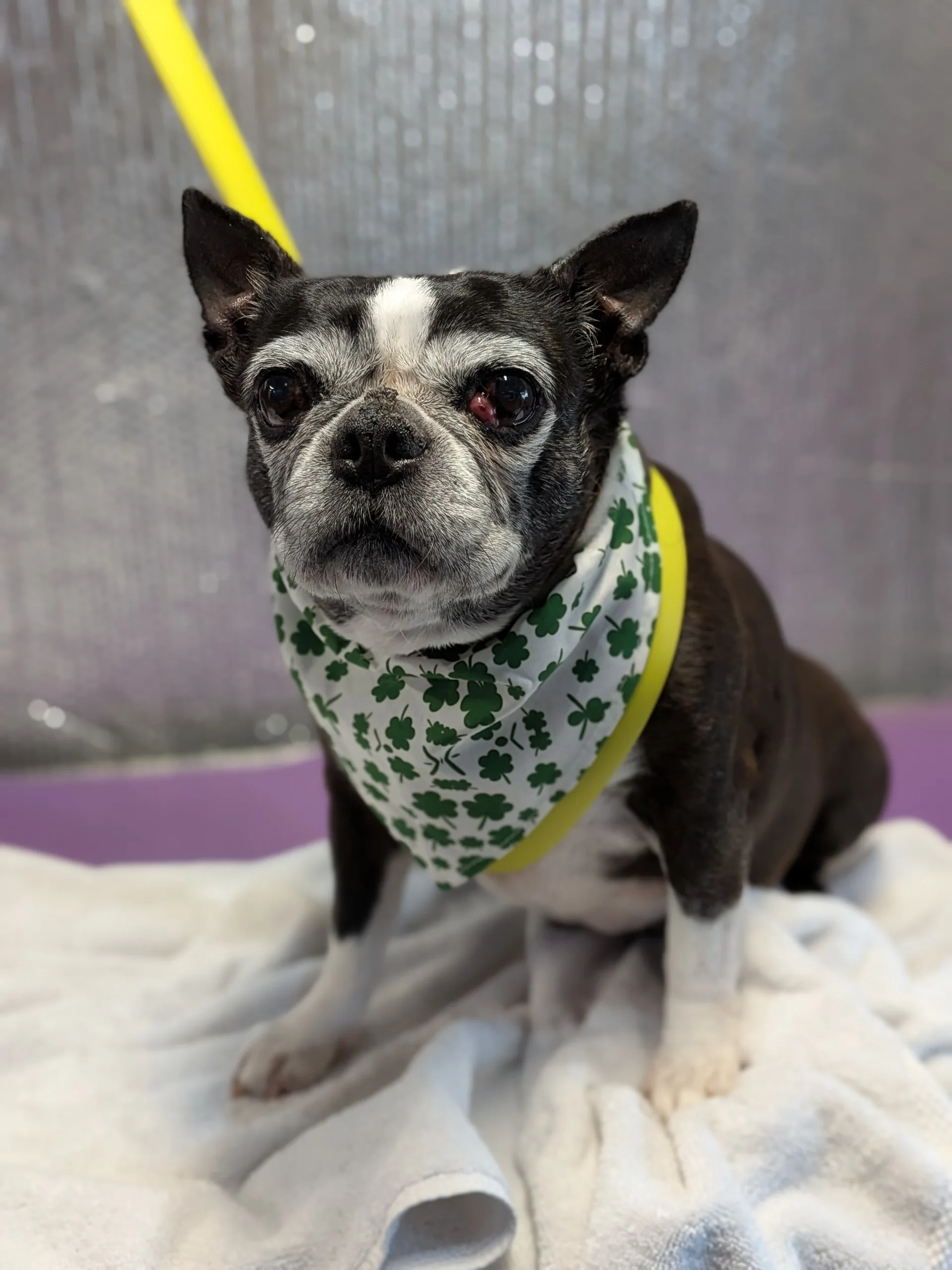
There is a senior Boston Terrier who has been hopping into my mobile van for years. Her name is Charlie, and every time she shows up, she brings this calm, gentle energy that makes the whole van feel warmer. She sits patiently while I work, leans in for a cuddle when I crouch down to her level, and gives that little satisfied sigh when she knows she is fresh out of the bath. She is the reason I am writing this post. Not because she is a rare or unusual dog. She is the opposite of that. She is the reason most people fall in love with the breed in the first place.
This is a guide to Boston Terriers, with Charlie as the example throughout. If you are researching the breed, considering one, or you already live with one and want to understand them better, this is for you. I am a mobile groomer, not a vet, and the medical information here is what I have learned from working on Boston Terriers over the years and from asking my own vet when something comes up. Always defer to your own vet for diagnosis and treatment.
Origin and History
The Boston Terrier is one of the few dog breeds that was actually developed in the United States. The breed was created in the late 1800s in Boston, Massachusetts, by crossing the English Bulldog with the now-extinct White English Terrier. The original dogs were larger and more pit-fighter in build than the Boston Terriers we know today. Over a few generations of selective breeding, the size came down, the temperament softened, and the tuxedo-like markings became a defining feature.
The American Kennel Club recognized the Boston Terrier in 1893. The breed was a popular companion dog in New England throughout the early 20th century, and it has remained one of the most popular small companion breeds in the United States ever since. It is nicknamed “The American Gentleman” because of the tuxedo coat pattern and the breed’s generally polite, friendly demeanor.
Appearance
Boston Terriers are small but muscular. Adults typically weigh between 12 and 25 pounds and stand 15 to 17 inches at the shoulder. The body is square and compact, with a broad chest, a short tail, and a build that is sturdier than it looks at first glance.
The most recognizable feature is the coat pattern. The official breed standard describes the ideal markings as a black, brindle, or seal base coat with white markings on the muzzle, between the eyes, on the chest, and on the legs. The look resembles a tuxedo, which is where the nickname comes from. Some Boston Terriers are mostly white with smaller patches of color, and some have more color than white. Both are common, but the symmetrical “tuxedo” pattern is the most iconic.
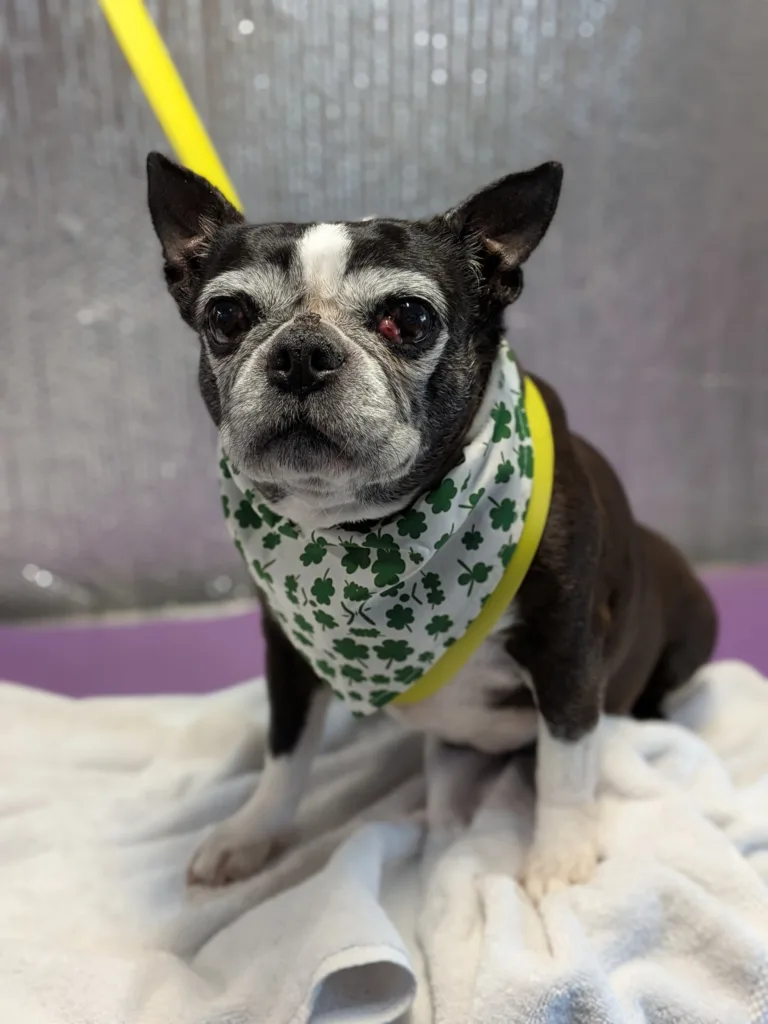
The face is brachycephalic, meaning it is short and flat. The muzzle is short, the jaw is broad, and the eyes are large, round, and set wide apart. The ears are small, erect, and pointed at the tips. Charlie’s face has all of these features in textbook form — the tuxedo blaze down the center of her forehead, the white muzzle, the dark round eyes, the perky ears that pick up every sound in the driveway.
The graying around Charlie’s muzzle, chin, and eyebrows is one of the signs that she is a senior. Boston Terriers typically live 11 to 13 years, and many start showing the silver face in their later years. It is the same kind of graying you see in older people. It is not a health issue. It is just time.
Temperament
Boston Terriers are known for being friendly, affectionate, and intelligent. They are people-oriented without being clingy, playful without being hyper, and they tend to get along well with other dogs, cats, and respectful children. They are not a working or sporting breed in the way a Labrador or a Border Collie is, and they do not need a job. They need company.
Charlie is a textbook Boston Terrier in this regard. She has been coming to the van for years, and she is the same calm, sweet dog every single time. She does not bounce off the walls when she arrives. She does not hide from the dryer. She just does her spa day, gets her cuddles, and goes home. That is the breed. They want to be near you, and they want to be part of whatever is happening, but they are not going to destroy your house if you have to run an errand.
Boston Terriers are also known for being smart and trainable. They pick up house training quickly, they learn commands fast, and they often do well in obedience and trick training. They respond best to positive reinforcement. They do not respond well to harsh corrections, and the breed tends to shut down if the training gets too heavy.
Health and Common Concerns
This is the section that matters most if you are thinking about getting a Boston Terrier, and it is the section where I owe you the most honesty.
Boston Terriers are a brachycephalic breed, and that flat face comes with a real list of health considerations. They are not a “set it and forget it” breed. They are a “pay attention and be ready to act” breed.
Eye issues are the single most common health concern in the breed. Boston Terriers’ large, prominent eyes are exposed and vulnerable. They are prone to corneal ulcers (scratches on the eye surface), dry eye, cataracts, glaucoma, and a condition called “cherry eye” where the third eyelid gland prolapses and shows up as a red mass in the corner of the eye. I have seen all of these in the van, and I have seen them often.
Charlie has visible eye changes that I am watching carefully. There is a red mass in the corner of her left eye that her vet is monitoring — that is the classic presentation of cherry eye, and depending on severity it can be managed with eye drops or it can require a small surgical procedure to reposition the gland. Her lenses are also showing some cloudiness, which is common in senior Boston Terriers and is most often either nuclear sclerosis (a normal age-related change that does not significantly affect vision) or early cataracts. Her vet is the one making that call. Mine is just to notice, mention it to the owner, and not pretend I am a vet.
If you live with a Boston Terrier, watch the eyes. Any redness, discharge, cloudiness, or visible mass is worth a vet visit. Eye issues in this breed can go from minor to serious in a matter of days.
Brachycephalic syndrome affects breathing. Boston Terriers’ shortened skull structure narrows the airways. Many of them snore. Many of them snort. Many of them overheat easily in warm weather because they cannot pant as efficiently as longer-muzzled breeds. Air travel is dangerous for them. Heat stress in summer is dangerous for them. This is not a breed that should be left outside in a hot yard, and it is not a breed that should be exercised hard in the heat of the day.
Other health concerns in the breed include:
- Patellar luxation (slipping kneecaps), common in small breeds
- Allergies and skin sensitivities, especially around the face folds
- Heart conditions, including a breed predisposition to a congenital heart issue called patent ductus arteriosus
- Spinal problems, including hemivertebrae (a malformed vertebra in the spine)
None of this is a reason to avoid the breed. Most Boston Terriers live full, happy lives. But it is a reason to do your homework before you bring one home, and a reason to have a good vet who knows the breed.
Grooming and Coat Care
Boston Terriers have a short, smooth coat that is one of the easiest to maintain in dog grooming. They shed year-round, but the shedding is light to moderate and a weekly brushing with a soft bristle brush or a rubber curry is usually all that is needed to keep loose hair off your furniture and your clothes.
Baths can be given every 4 to 8 weeks depending on the dog’s lifestyle. Boston Terriers do not have an undercoat, so the bath is a quick affair. The face folds need attention — those little wrinkles around the muzzle and nose can trap moisture, food, and bacteria if they are not cleaned regularly. A damp cloth or a pet-safe wipe once or twice a week is the standard recommendation.
The eyes need to be checked at every grooming. Discharge can build up in the corners, and the prominent eye shape means any irritation shows up quickly. I do not put grooming products near the eyes, and I tell Boston Terrier owners to be similarly careful with anything they apply to the face.
Charlie comes in for her Full Groom on a routine schedule. We do her bath, her blow dry on a low setting, her face fold cleaning, her ear cleaning, and her nail trim. She does not need a haircut. The breed does not have hair that grows long enough to require trimming. The work is in the maintenance, not the styling.
Living with a Boston Terrier
Boston Terriers are an excellent fit for a lot of households. They are small enough for apartment living. They are calm enough for older owners. They are sturdy enough to handle respectful children. They do not need a yard, but they do need daily attention and at least one or two short walks a day. They get cold easily in winter — many of them need a sweater or coat when the temperature drops — and they get hot easily in summer, so the climate has to be managed.
The most important thing to know about living with a Boston Terrier is that they want to be with you. They are not a breed that does well being left alone for long hours. They thrive on companionship, and the bond they build with their people is the whole point of the breed. Charlie has been with her family for years, and the bond is obvious every time she hops into the van. She trusts me because her family trusts me, and the routine we have built together over the years is part of why her spa day is so easy for her.
If you are a Boston Terrier owner reading this, the best thing you can do for your dog is to be consistent. Same feeding schedule, same walking routine, same grooming cadence. Boston Terriers thrive on predictability, and a dog that knows what is coming is a dog that is calm and happy in every part of its life.
The Wrap
The Boston Terrier is a small dog with a big personality, a tuxedo coat, a flat face, and a list of health considerations that any owner needs to take seriously. The breed is also one of the most affectionate, trainable, and good-natured dogs you can bring into your home. Charlie is a perfect example of what the breed is at its best — calm, sweet, patient, and deeply bonded to her family.
If you are thinking about a Boston Terrier, talk to your vet about the breed’s eye and breathing concerns before you commit. If you already have one, watch the eyes, keep the face folds clean, and stay on top of the grooming routine. The breed is generally healthy when cared for properly, and a senior Boston Terrier like Charlie is a reminder of how long the relationship can last when you do it right.
How to Reach Me
If your Boston Terrier is due for a groom, the best way to get started is through the New Client Form. Use the note section to tell me about your dog’s age, any eye issues, any breathing concerns, and how your dog does with the dryer and the nail clippers. That helps me plan the session before I pull into your driveway.
Current clients with a question about a Boston Terrier eye, a face fold, or a grooming routine can drop it in the live stream chat and I will answer it on air.
Want to see a real Boston Terrier groom in real time? Head over to vroomgrooms.com and click the Live button. We stream real appointments every week on Twitch at DogGroomerNicole. Real grooming, real dogs, real community. We do not stage the dogs. We do not fake the results. If a dog is having a rough day, you will see that too. That is the whole point.
Serving Northwest Ohio: Bowling Green, Grand Rapids, Haskins, Holland, Maumee, Monclova, Northwood, Oregon, Perrysburg, Rossford, Swanton, Sylvania, Toledo, Walbridge, Waterville, and Whitehouse. Mobile Dog Grooming. We come to you. No hook ups needed!
Stay fresh and furry,
Nicole / Vroom Grooms LLC
About the Author
Nicole is the owner and certified groomer behind Vroom Grooms LLC, a mobile dog grooming service serving Northwest Ohio. She specializes in brachycephalic breeds, anxious dogs, and clients who want honest, transparent grooming without the salon chaos. You can catch her live on Twitch at DogGroomerNIcole, where she streams real grooms and talks shop about the grooming world.
This post was drafted with help from Nagini 🐍, her digital assistant, who keeps the blog running, handles the tech side of the website, and makes sure Nicole spends more time with dogs and less time wrestling with WordPress.