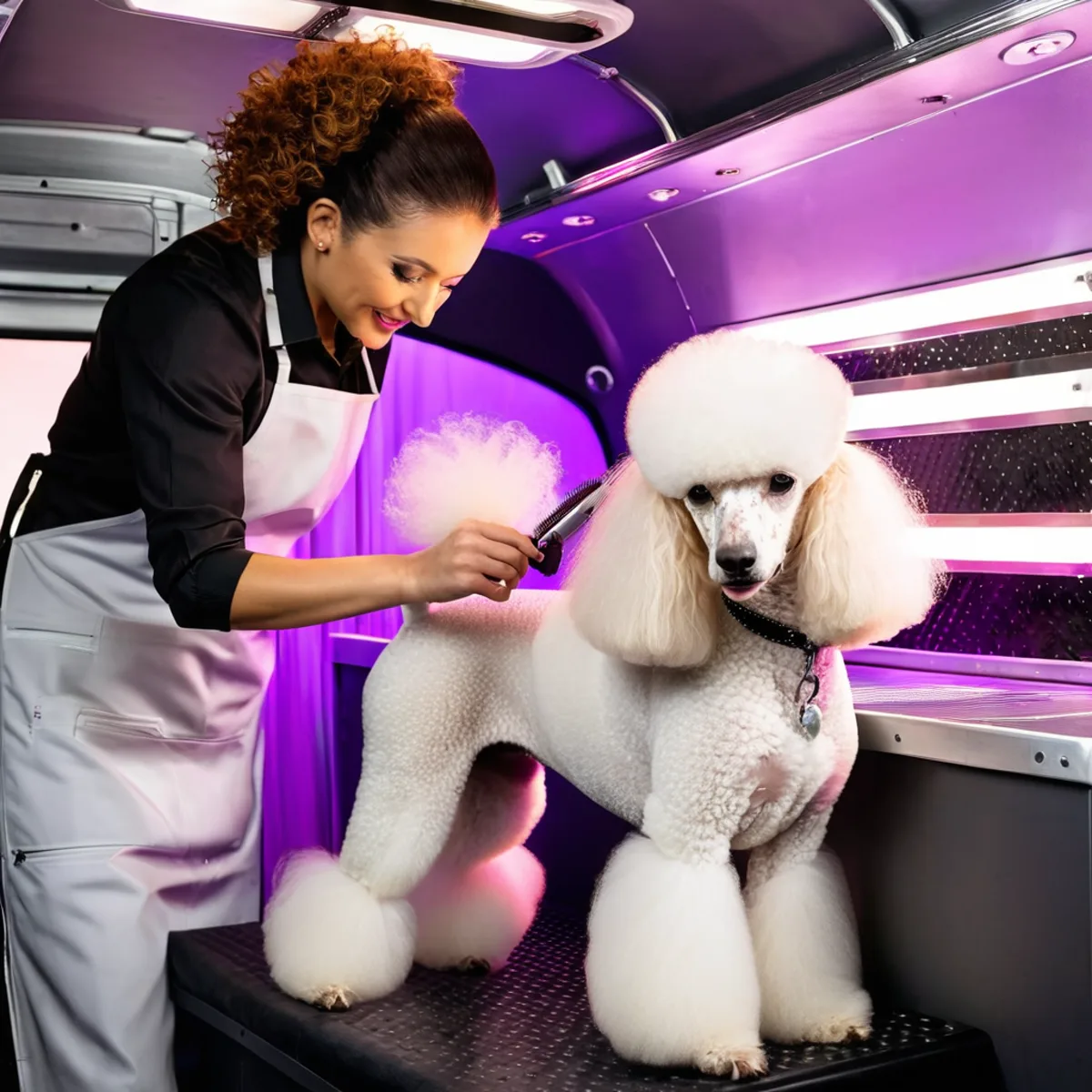
I am going to say something that might be controversial: I think most dog owners should be brushing their dogs at home between professional grooms. Yes, I am a professional groomer telling you to do some of the work yourself. But that does not change the fact that professional grooming, done regularly, is one of the best things you can do for your dog’s health, comfort, and quality of life. Let me explain why.
What a Professional Groomer Actually Does
A lot of people think grooming is just a bath and a haircut. If that is what you think, you are missing most of what a full groom involves. At Vroom Grooms, a Full Groom includes:
– A bath with coat-appropriate shampoo (and conditioner when needed)
– A full blow dry, brushed out as we dry
– A nail trim
– Ear cleaning
– The haircut or de-shed, depending on what the dog needs
– Teeth brushing
– Anal gland expression (external, when appropriate)
– A full body check for skin issues, lumps, ear issues, paw pad condition, and anything else worth flagging
That is a lot more than a bath. And every single one of those steps is something most dog owners either cannot do safely, do not have the tools for, or do not have the experience to do well.
The Tools Matter
Professional groomers invest in equipment that costs thousands of dollars. High-velocity dryers, professional clippers with sharp blades, hydraulic tubs, proper restraint systems, full lighting, and a complete range of coat-specific products. The at-home equivalent of this is a bathtub, a hair dryer, and some kitchen scissors. The results are not the same.
I have seen so many DIY groom jobs that ended with the dog looking like a patchwork quilt because the owner used scissors where they should have used clippers. I have seen nail trims gone wrong, with the quick cut and the dog bleeding. I have seen ear cleanings that packed debris deeper into the ear canal instead of removing it. I have seen bath-and-blow-dry attempts that left the coat damp and led to hot spots and skin infections.
These things do not happen because owners are bad people. They happen because grooming is a skill, and like any skill, it takes training, practice, and the right tools to do well.
The Eye for Detail
One of the things you cannot teach in a YouTube video is the eye. A professional groomer notices things. A small lump behind the ear. A black spot on the belly that was not there last time. A toenail that is growing sideways. A patch of dry skin on the lower back. A redness in the ear that might be the start of an infection. We see dozens of dogs a week, and we know what normal looks like, so we know when something is not normal.
I cannot tell you how many times I have flagged something to an owner and saved them a much bigger vet bill down the road. A hot spot caught early is a quick fix. A hot spot left for a month is a skin infection and a course of antibiotics.
The Coat Knowledge
Every coat type is different. A Poodle clip and a Golden Retriever trim and a Pit Bull de-shed are three completely different skill sets. A professional groomer knows how each coat behaves, what tools to use, what products to use, and what finish to aim for. They also know what to avoid. You do not want to use the same technique on a Husky that you would use on a Bichon, and vice versa.
If you are doing the grooming at home, you are essentially trying to become your own expert on your dog’s specific coat. That is possible, and I respect owners who put in the work, but it is a steep learning curve and the consequences of getting it wrong can be uncomfortable for the dog.
The Stress Factor
This is the big one for me. A lot of dogs are stressed by at-home grooming because the tub is slippery, the hair dryer is loud, the clippers are weird, and their owner is nervous. The dog picks up on the owner’s anxiety, and suddenly what should be a calm routine becomes a wrestling match.
A professional grooming setup is designed to minimize stress. Non-slip surfaces, proper restraint, professional dryers with variable speed, and a groomer who knows how to read a dog’s body language. A lot of dogs that hate being groomed at home are perfectly fine at a salon or in a mobile grooming van, because the environment is set up for success.
What You Can Do at Home
I am not saying you should not do anything at home. Between professional grooms, you should be:
– Brushing your dog regularly (the right brush for the right coat)
– Checking ears, eyes, teeth, and paws weekly
– Wiping down paws after walks in bad weather
– Cleaning facial folds on brachycephalic breeds
– Giving an at-home bath when needed, with a gentle rinse and thorough dry
These are the at-home maintenance tasks that keep your dog comfortable between professional appointments. They are not a substitute for a full groom, but they make the full groom easier, faster, and more pleasant for the dog.
The Bottom Line
I am going to be honest with you: professional grooming is a luxury service. All pet care can technically be done at home, and a lot of owners do it themselves. That is a valid choice, and I respect it. But for owners who do choose to bring their dog in for professional grooming, the value is real. The cost of a full groom every 4 to 6 weeks is a fraction of what you would pay for a vet visit to treat a skin infection, an ear infection, an impacted anal gland, or a mat that had to be cut out under sedation. The math works out in favor of the regular groom, every time.
Stay fresh and furry, Nicole / Vroom Grooms LLC
About the Author
Nicole is the owner and certified groomer behind Vroom Grooms LLC, a mobile dog grooming service serving Northwest Ohio. She has been certified since 2020 after completing 640 hours of hands-on training, and has seen thousands of dogs in the van. You can catch her live on Twitch at DogGroomerNIcole, where she streams real appointments and shows what a full groom actually involves.
This post was drafted with help from Nagini 🐍, her digital assistant, who keeps the blog running, handles the tech side of the website, and makes sure Nicole spends more time with dogs and less time wrestling with WordPress.