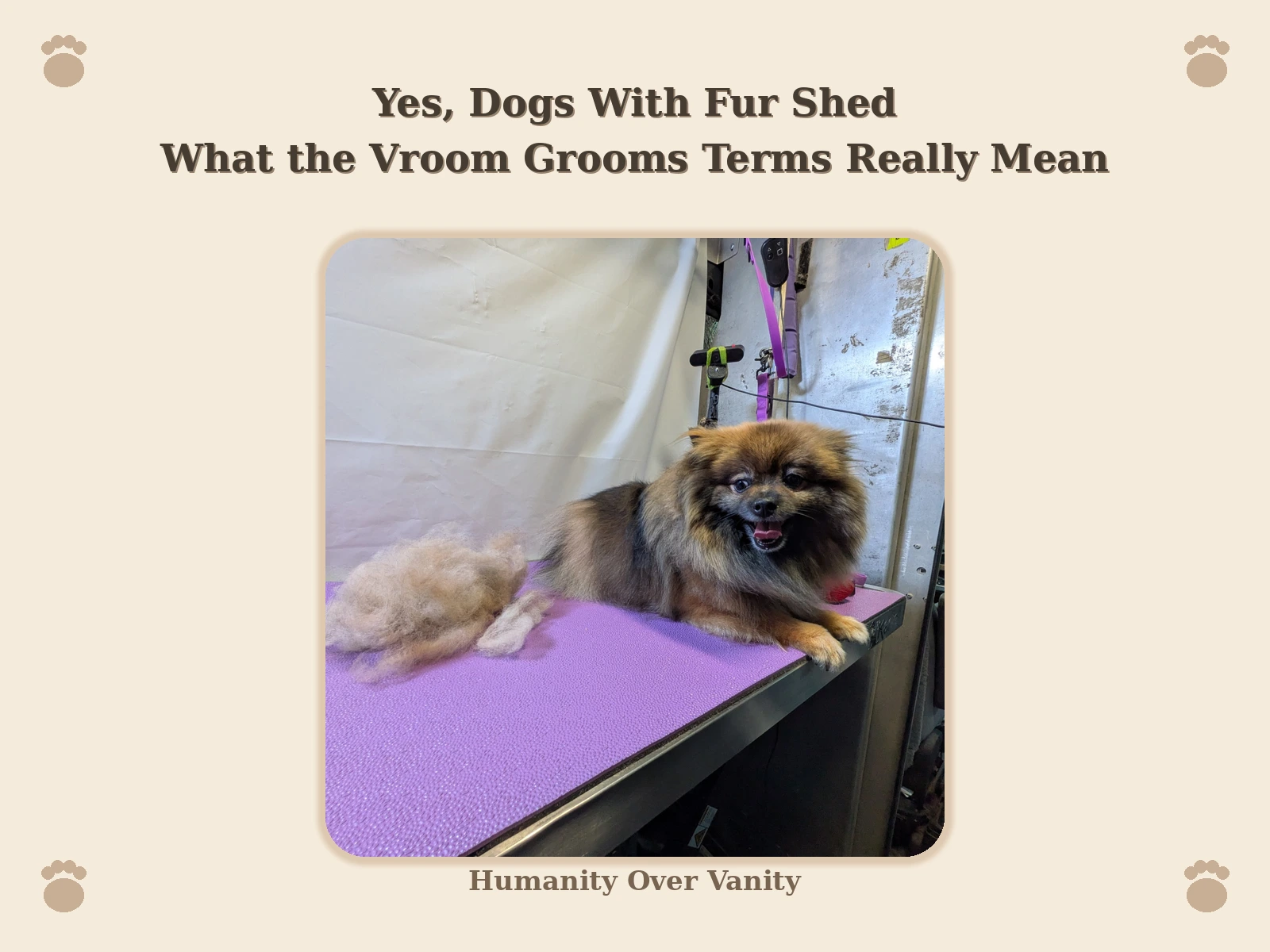
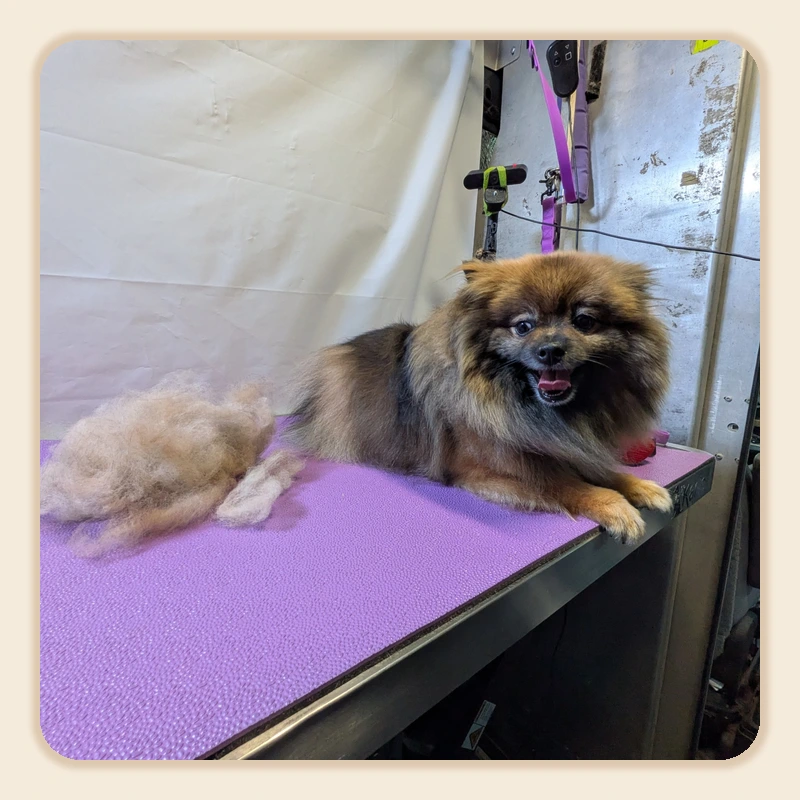
Every double-coated dog — Pomeranians, Huskies, Aussies, Berners, retrievers, Pyrenees — has an undercoat that is designed to come out. Brushing is what triggers it. Combing, deshedding tools, blow-outs, and regular grooms all speed the process up. The fur you see here came off Bear in a single session, and he is happier, cooler, and visibly more comfortable without it.
The Terms and Conditions at Vroom Grooms LLC include a section that starts with “Yes, dogs with fur do shed.” The amount of fur a dog sheds depends on the breed, the time of year, and whether they have a single or double layer of fur. A dog’s fur helps control their body temperature and protects their skin against the sun and other environmental elements. When a dog’s hair stops growing, they naturally lose it by shedding. Even curly coats shed, though curly coats hold on to shed fur. We recommend brushing. Here is what this actually means for you and your dog.
Yes, Dogs Shed
This may seem obvious to most dog owners, but the Terms include this statement because there are people who believe otherwise. Some owners think that certain breeds (Poodles, Bichons, Yorkies) do not shed. They do shed. All dogs shed. The difference is how much loose hair ends up on your furniture.
Single-coated breeds and breeds with continuously growing hair (like Poodles) do not “blow coat” the way double-coated breeds do. They do not have a seasonal mass-shed where the entire undercoat releases at once. But they still lose individual hairs as the hair growth cycle completes. Those hairs get caught in the surrounding coat instead of falling out, which is why Poodles need regular brushing and professional grooming. The hair is still being shed. It is just being retained in the coat instead of dropping onto your couch.
Double-coated breeds (Huskies, Golden Retrievers, German Shepherds, Bernese Mountain Dogs) shed year-round, with two major seasonal blows in spring and fall. The undercoat releases in large amounts, and the loose hair ends up everywhere unless it is managed with regular brushing and professional de-shedding appointments.
Short-coated breeds (Pit Bulls, Beagles, Boxers) shed less visibly because the hair is short and fine, but they shed constantly. The hair does not get caught in anything. It just falls out and accumulates on your floors, your clothes, your car seats, and your food.
How Shedding Works
A dog’s hair grows in cycles. There is an active growth phase (anagen), a transition phase (catagen), and a resting/shedding phase (telogen). When a hair reaches the end of its growth cycle, it falls out and is replaced by a new hair growing from the same follicle. This happens continuously across the dog’s coat, but it is not synchronized. Some hairs are growing while others are shedding. The overall effect is a steady turnover of the coat.
For double-coated breeds, the undercoat has a more dramatic seasonal pattern. As daylight length changes and temperatures shift, the dog’s body gets hormonal signals that trigger a coordinated release of the undercoat. This is the “blowing coat” phenomenon. It happens twice a year in most climates, and it produces a startling amount of fur over a few weeks.
Why Shedding Is Healthy
Shedding is not a problem. Shedding is a sign that the dog’s coat is functioning normally. A dog that is not shedding at all (or is shedding very little) may have a health issue — hormonal imbalance, poor nutrition, skin disease, or stress. Normal shedding means the hair follicles are healthy, the coat is growing and replacing itself, and the skin underneath is being maintained.
The Terms are explicit about this: “When a dog’s hair stops growing, they will naturally lose it by shedding.” Shedding is not a failure of the dog or the groom. It is the natural cycle of the coat.
How Vroom Grooms Manages Shedding
Vroom Grooms manages shedding through:
– Regular brushing at home. This is the most important thing. Brushing removes loose hair before it ends up on your furniture. The frequency depends on coat type, but most dogs benefit from at least weekly brushing.
– Professional de-shedding appointments. For double-coated breeds, a de-shedding treatment at Vroom Grooms removes a significant amount of loose undercoat. The Terms recommend this as part of the grooming routine.
– Bathing and blow drying. The bath and high-velocity dryer loosen and remove dead hair that brushing alone cannot reach. This is part of every full groom.
– Coat-appropriate products. The right shampoo and conditioner help maintain the coat’s health and support the natural shedding cycle.
The Terms acknowledge that shedding cannot be stopped. It can only be managed. The goal of regular grooming is to keep the shedding controlled, not to eliminate it.
Even Curly Coats Shed
The Terms specifically note that even curly coats shed. This is a common misconception. Poodle owners in particular often believe their dog is “non-shedding” because they do not see hair on the furniture. The hair is being shed, but it is being retained in the surrounding coat. Without regular brushing and grooming, that retained hair turns into mats. The mats get bigger, denser, and harder to deal with. Eventually, the dog ends up shaved down because the coat could not be maintained.
If you have a curly-coated dog (Poodle, Doodle, Bichon, Portuguese Water Dog, etc.), regular brushing and professional grooming are not optional. They are how you manage the shedding that is happening whether you see it or not. The Terms are explicit about this so there is no misunderstanding: curly coats shed. They just shed into themselves instead of onto your floor.
What About Hypoallergenic Breeds
No dog is hypoallergenic. This is covered in detail elsewhere on the Vroom Grooms blog, but it is worth repeating here. People who are allergic to dogs are allergic to the proteins in dog saliva, urine, and dander (dead skin flakes), not to the hair itself. Breeds that are marketed as “hypoallergenic” (Poodles, Bichons, etc.) may produce less dander or shed less hair into the environment, which can help some allergy sufferers. But they still produce the allergens. There is no dog that is safe for everyone with allergies.
If you have dog allergies and you are considering a dog, spend time with the breed before you commit. If you already have a dog and your allergies are a problem, talk to your doctor about management options. The groomer is not a medical professional and cannot give you advice on allergies.
What You Can Do
The Terms recommend brushing. That is the single most important thing you can do to manage shedding. Beyond that:
– Keep your dog on a regular grooming schedule (every 4 to 6 weeks for most breeds)
– Use the right brush for your dog’s coat type (slicker brush, undercoat rake, bristle brush, etc.)
– Bathe your dog at home between professional grooms if needed, with a dog-specific shampoo
– Feed a high-quality diet that supports skin and coat health
– Watch for changes in shedding that might indicate a health issue (sudden heavy shedding, bald spots, skin irritation)
If your dog is shedding more than usual, talk to your vet. Excessive shedding can be a sign of stress, poor nutrition, hormonal imbalance, or skin disease. Normal shedding is steady and predictable. Sudden or extreme shedding is worth a vet visit.
The Bottom Line
All dogs shed. Some shed more visibly than others. Some shed into their own coat instead of onto your floor. The Terms at Vroom Grooms are explicit about this so there is no misunderstanding. Regular brushing, professional grooming, and a healthy diet are how you manage shedding. There is no way to stop it. There is only a way to keep it controlled.
Stay fresh and furry, Nicole / Vroom Grooms LLC