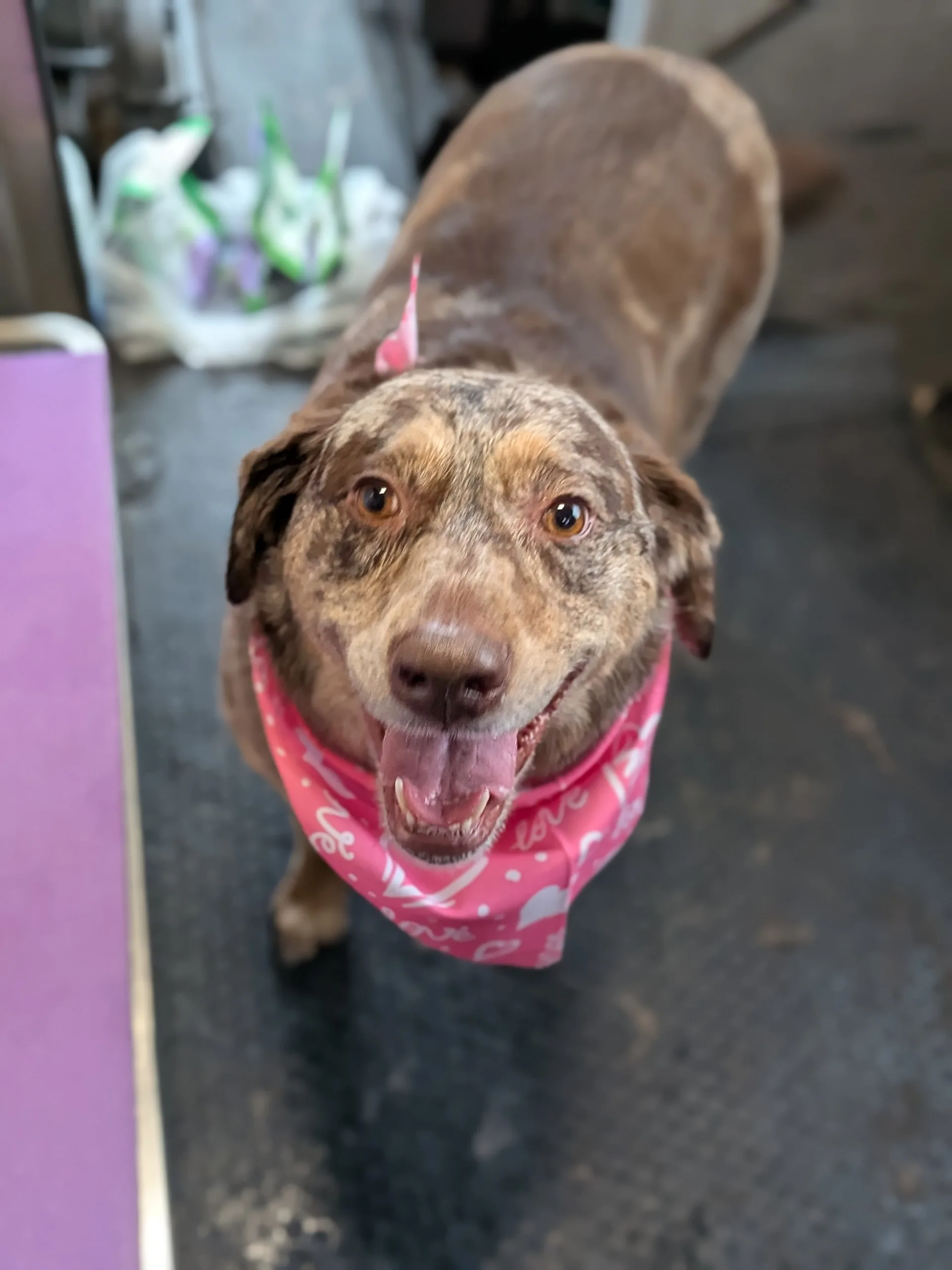
Run your hand along your dog’s cheek and you will feel them. A row of small raised bumps, each one with a stiff hair sticking out of it. Every dog has them. Every groomer has had a client ask about them. They are not a rash, they are not bug bites, and they are not something that needs treating. Those bumps are hair follicles, and the hair coming out of them is a whisker.
What Those Bumps Actually Are
Whiskers are not the same thing as the rest of your dog’s coat. They have their own name, vibrissae, and they work differently from regular hair. A whisker sits deeper in the skin than a normal hair, and the follicle it grows from is bigger and far more sensitive.
Inside each of those little bumps is a dense cluster of nerve endings. That is the whole point of the bump. The follicle is packed with touch sensors, so the slightest bend of the whisker sends a signal straight to the brain. A regular hair can be brushed without your dog noticing. A whisker cannot be moved without your dog knowing.
That is why the bump is raised. You are feeling the sensory organ itself.
Why They Are Where They Are
Whiskers grow in specific places, and the placement is not random. Dogs have them on the muzzle, on the cheeks, above the eyes, and under the chin. The ones above the eyes sit where they can catch anything drifting toward the eyeball.
You can test the reflex yourself, and it is a good party trick. Tap a whisker gently and the eye on that same side of the face will blink. Tap again and your dog will turn his head away from your hand. That blink is not a flinch. It is a protective circuit doing exactly what it was built to do.
Whiskers Read the Air
Here is the part that surprises people. Your dog does not have to touch anything for his whiskers to work.
As a dog moves, he pushes air around him. When he gets close to a wall, a table leg, or your leg, some of that air bounces back. The returning air bends the whiskers, and the follicles read the bend. Your dog works out that something is there before he ever makes contact with it. Call it radar, because that is basically what it is.
This matters most in the dark and in tight spaces. A dog with intact whiskers moves through a dim room with confidence, because he is getting information from his face the whole way. The AKC notes that dogs whose whiskers have been removed actually move more slowly in low light. They lose the feed that tells them what is where, so they have to be careful instead.
If you have ever wondered how your senior dog still finds the water bowl in a dark hallway, this is part of the answer.
The Grooming Part, Asked Plainly
Whiskers do grow back, and cutting one does not hurt, because the nerves live in the follicle and not in the hair itself. But that does not make trimming them a good idea.
Groomers have cut whiskers for a long time, mostly for a clean-looking muzzle on certain breeds. The AKC’s own advice on this is direct: next time you are at the groomer, tell them to leave the whiskers alone. Losing them takes away a sense your dog uses every day to move through the world and to know what is close to his face.
When I trim around a dog’s face, I work around the whiskers rather than through them. The hair on the muzzle that needs tidying is a separate thing from the whiskers themselves, and it is possible to clean up a face without taking them off. If your current groomer is trimming them and you would rather they did not, it is a completely fair thing to ask for. Say it plainly at drop-off and most groomers will happily leave them.
One more note, because it comes up with older dogs. If your dog is a senior, or is losing vision, those whiskers are doing more work than ever. Leave them exactly where they are.
What to Watch For
The bumps themselves are normal and should stay quiet. What you want to notice is change. A bump that suddenly swells, crusts, bleeds, or turns red is not a whisker follicle doing its job, and it deserves a look from your vet. The same goes for a whisker that falls out and does not grow back, or a dog who starts rubbing his face against the carpet.
Normal whisker follicles are small, smooth, and identical on both sides of the face. Once you know what they feel like, you will notice right away when one of them does not belong.
The Short Version
Those bumps on your dog’s cheeks are hair follicles, they hold whiskers, and the whiskers are one of the most sensitive tools on your dog’s whole body. They sit deep, they read air currents, and they warn your dog about things he cannot see. Nothing about them needs fixing. The right move is to leave them alone and let them work.
New to Vroom Grooms? Fill out the New Client Form to get started. I am currently booking new clients onto a waiting list, and I will reach out when a spot opens up. Already a current client? Text me at 419-315-4989, the line I actually answer.
Stay fresh and furry! 🐾
Catch the Action Live! Want to see grooming transformations happen in real-time? Tune into the solo live stream over on Twitch at DogGroomerNicole. Whether we are tackling tricky coat conditions, working with different breeds and weight classes, or just enjoying some puppy cuddles, you can watch it all unfold straight from the van.
While you are watching from your laptop or desktop, please take a moment to click the link below the stream to learn more about Folds of Honor, a phenomenal charity we are incredibly proud to support.
See you all on the road!
About the Author
Nicole is the owner and certified groomer behind Vroom Grooms LLC, a mobile dog grooming service serving Northwest Ohio. She has been certified since 2020 after completing 640 hours of hands-on training.
This post was drafted with help from Nagini 🐍, her digital assistant, who keeps the blog running, handles the tech side of the website, and makes sure Nicole spends more time with dogs and less time wrestling with WordPress.
Sources