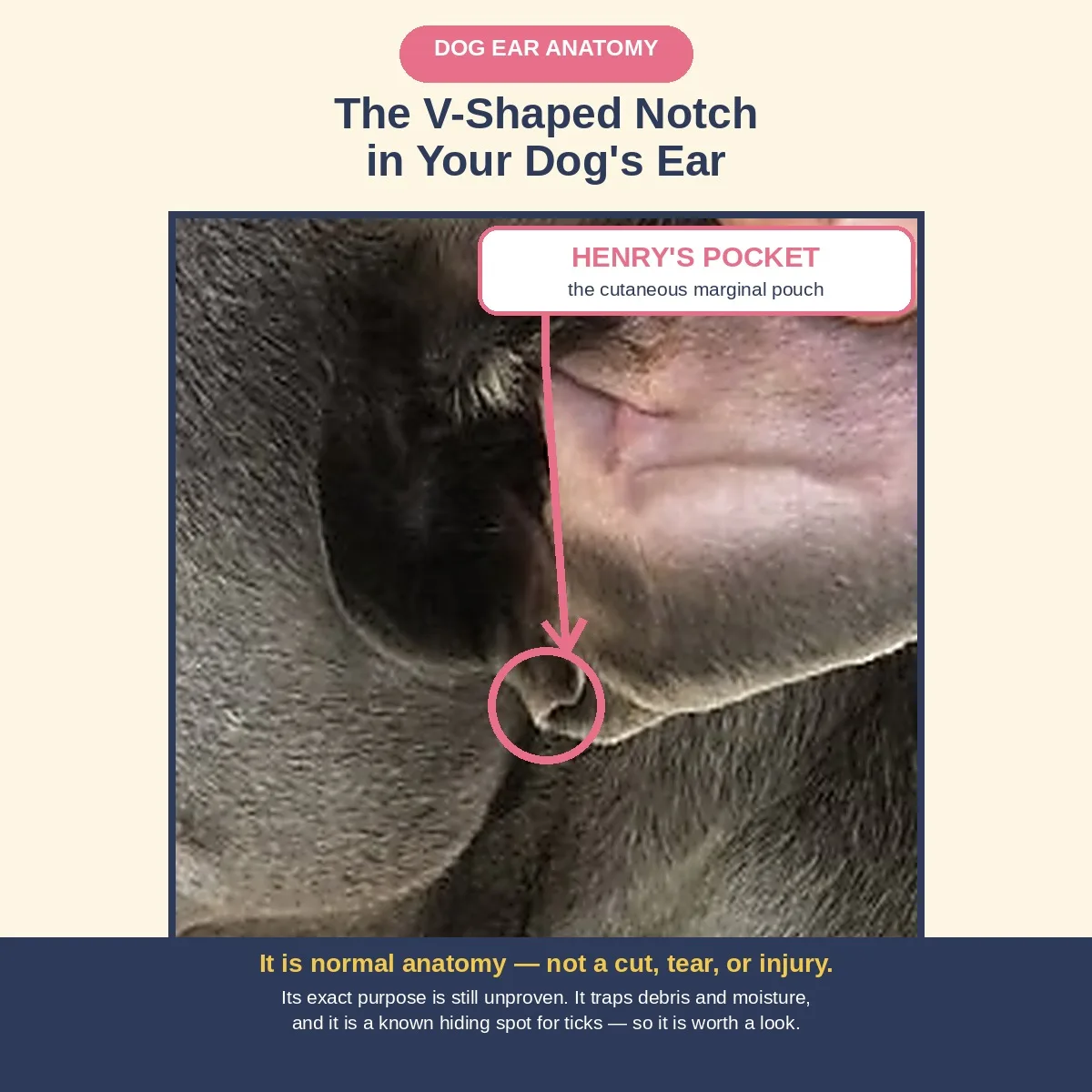
Every few weeks somebody asks me the same thing while I am holding their dog’s ear. “What is this little notch? Did somebody cut her ear? Is this a scar?”
They are usually pointing at a small V-shaped slit on the lower rear edge of the ear flap. It looks deliberate. It looks like it should mean something.
It does have a name, and it does have a story. The story is just not the one people expect.
It Has Two Names
The everyday name is Henry’s pocket. The formal anatomical name is the cutaneous marginal pouch. Same feature, two labels — one is the nickname that stuck, the other is what you will find in veterinary anatomy references.
It is a fold of skin that forms a small open pouch on the lower rear part of the external ear. On your dog it sits down near the base of the ear, on the outer edge — the side that faces back, not the side that faces forward.
It Is Not a Cut, a Tear, or an Injury
This is the part I want to be clear about, because it is the reason most people ask.
Henry’s pocket is normal anatomy. It is not a scar. It is not a healed wound. It is not a breeder’s mark or a notch somebody put there. It is not a sign that your dog was in a fight, and it is not something you did wrong.
It was there before you noticed it, and it will be there after. If you just found it this week, you did not miss anything — plenty of owners have petted their dog’s ears for years before somebody points it out.
So What Is It For?
Here is the honest answer: nobody knows for certain.
That is not me being cagey. The function of the pouch is genuinely listed as unknown in the veterinary anatomy literature. It shows up in a wide range of mammals — not just dogs and cats, but also animals like weasels and bats — which suggests it is an old feature that got carried forward rather than something that evolved for one specific job.
There are a few working theories, and they are theories rather than settled facts:
- Hearing. The most common idea is that the pouch helps a dog pick up high-pitched sounds by softening or filtering lower ones, especially when the ear is angled. That kind of directional hearing matters a lot to a predator.
- Ear movement. Because it is a fold, it may simply give the ear more freedom to rotate and to flatten back against the head.
- Structural. It may reinforce the ear at that point rather than do anything active at all.
It could also be some combination of those, or none of them. Until somebody studies it properly, the accurate answer is that we know what it is, where it is, and that it is normal — and we do not know exactly what it does.
Almost Every Cat Has One, and Plenty of Dogs Do Too
The pouch is easiest to see on short-coated dogs and on dogs with erect ears, because there is less hair covering the edge of the ear. On floppy, heavily feathered ears it is usually still there — you just cannot see it without parting the fur.
Cats have it too, which surprises people who assume it is a dog thing.
The Part Only a Groomer Notices
I spend my day working around dog ears, so this is the part I know best.
Henry’s pocket is one of the spots on the ear that groomers treat with real caution. The skin there is thin, and it sits in a fold, which means it is very easy to catch with a clipper blade or the tip of a pair of scissors. This is well documented in professional grooming literature — the cutaneous marginal pouch is routinely described as one of the most commonly nicked areas of the ear.
The safe technique, for anyone curious: work from the center of the ear outward toward the edge, hold the ear flat and supported from behind, and keep the pouch centered in the blade rather than catching it with the corner. Same idea with scissors — tip them toward the tip of the ear and keep the skin lifted away from what you are cutting.
None of that is a reason to be nervous. It is just why a groomer who knows ears handles that edge slowly. It is the same reason I am careful about what I will and will not do on a dog’s coat — if you have ever wondered what a groomer should and should not be doing, that is a separate post of mine.
What You Should Actually Do About It
Not much — but “not much” is not the same as “nothing.”
Because it is a skin fold, the pouch is a warm, sheltered spot. That makes it a place where ordinary debris, moisture, and the occasional hitchhiker can collect. Ear folds in general are a known spot to find ticks and fleas, and the ear is one of the places to check after your dog has been outside.
So when you are handling your dog’s ears, which you should be doing regularly anyway:
- Look at the pocket and the surrounding edge. Know what your dog’s normal looks like.
- Wipe the visible outer part with a cotton ball or a soft cloth if it looks grubby. That is as far as it goes.
- Do not dig into it with a cotton swab or anything pointed. You cannot see where it goes, and pushing debris deeper is worse than leaving it.
- Do not clean a healthy ear on a fixed schedule. Over-cleaning irritates the skin and can invite the very problems you are trying to avoid. I wrote a full guide on why that is, and on the L-shaped canal that makes ears trickier than they look: Dog Ear Cleaning Guide: What Is Normal.
Call your vet instead of cleaning if the pocket or the ear around it is red, swollen, hot, painful to touch, or smells. Swelling at that spot is not the pocket itself acting up — it usually means something else is going on and needs to be looked at properly.
If You Just Found It, You Are Fine
The reason people ask me about this is almost never a problem. It is that they have just noticed it and it looks strange enough to worry about.
It is not strange. It is one of those small reminders that a dog’s body has parts we inherited the same way they did, and that we do not fully understand every piece of.
Check it now and then. Keep the ear dry. Leave the rest alone.
Humanity over vanity — always.
New to Vroom Grooms?
If your dog needs regular grooming, the best way to get started is through the New Client Form. Use the note section for anything I should know — health conditions, behavioral quirks, coat preferences, or anything else I should be aware of before I pull into your driveway.
If you are already a current client and there is new information about your dog, text it to me directly. Anything that could affect the time or the grooming session needs to come in as soon as possible, or at least 48 hours before your appointment, in case I need to adjust my schedule or reschedule.
Ask me in person during your next appointment, or pop into my live stream on Twitch.tv/DogGroomerNIcole.
About the Author
Nicole is the owner and certified groomer behind Vroom Grooms LLC, a mobile dog grooming service serving Northwest Ohio. She specializes in double-coated breeds, anxious dogs, and clients who want honest, transparent grooming without the salon chaos. You can catch her live on Twitch at DogGroomerNIcole, where she streams real grooms and talks shop about the grooming world.
This post was drafted with help from Nagini 🐍, her digital assistant, who keeps the blog running, handles the tech side of the website, and makes sure Nicole spends more time with dogs and less time wrestling with WordPress.
Sources