Every dog owner eventually finds it by accident. You are rubbing your dog’s front leg, working your way down toward the paw, and your thumb catches something on the back of the leg — a small, tough, leathery patch of skin sitting there all by itself. No toe attached to it. No claw. Just a pad, in a place a pad does not seem to belong.
Plenty of people assume it is a scar, a callus, or a wart. It is none of those. It is a normal part of the dog’s foot, it has a name, and it has a job.
It Is Called the Carpal Pad
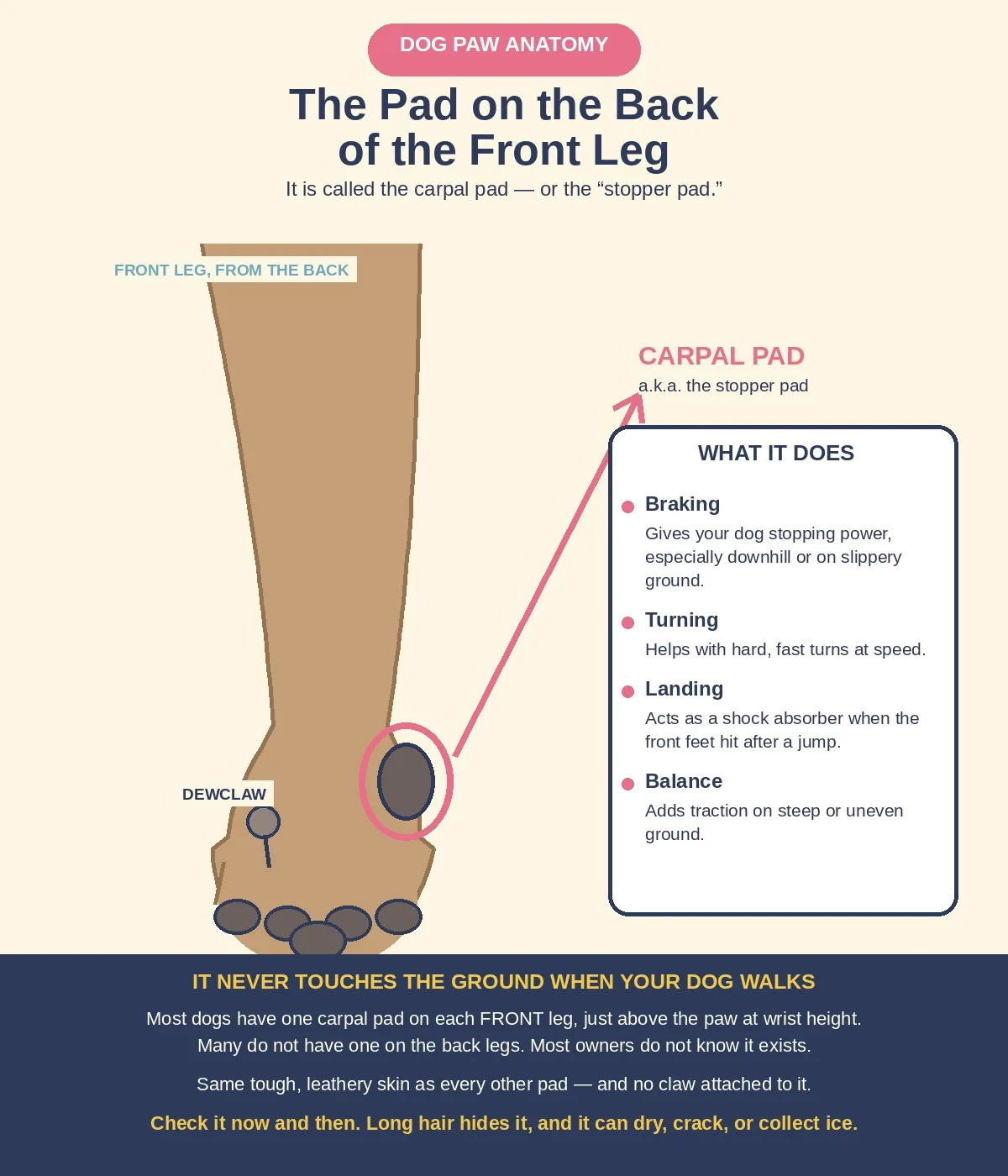
The formal name is the carpal pad, because it sits at the level of the carpus — the dog’s wrist joint. Groomers and dog-sport people usually call it the stopper pad, which tells you a lot about what it does.
It is located on the back of the front leg, just above the paw. If your dog has a dewclaw, the carpal pad sits above it on the outside of the leg.
Structurally it is the same material as every other pad on your dog: thick, layered, leathery skin over fat and connective tissue. The one difference is that it has no claw attached to it.
Where You Will and Will Not Find It
Dogs have carpal pads on their front legs. Many dogs do not have them on the back legs, and that is normal.
There is a reason for the front-leg bias. The front legs hit the ground first and carry most of the dog’s weight — a good deal more than half of it. They are also the steering and the brakes. The carpal pad is a front-end piece of equipment because the front end is doing the work that needs it.
If your dog is long-haired or heavily feathered around the legs, you may never have seen it. It is still there. Parting the fur will find it.
What the Stopper Pad Actually Does
Here is the part that changes how you watch your dog move.
The carpal pad does not touch the ground when your dog walks. It sits too high up the leg. In a normal walk or trot, it never makes contact.
That is precisely why it confused so many people for so long. A pad that never touches the ground looks like a leftover part. It is not. It is reserved for the moments when your dog is moving hard.
When a dog canters or gallops, there is a brief instant in the stride where that pad does meet the ground. In those moments, it does four things:
- Braking. It gives your dog stopping power — especially useful coming downhill or on a slippery surface, where a dog needs grip that the normal pads cannot provide fast enough.
- Turning. It adds traction for hard, fast turns at speed.
- Landing. When your dog lands after a jump, the front feet take the impact first. The carpal pad acts as a shock absorber, reducing the jolt through the leg.
- Balance. It helps your dog stay upright on steep, uneven, or unstable ground.
You will never see it working in a still photo. You can sometimes catch it in slow-motion video — that is how researchers and veterinarians identified what it does, by slowing down footage of dogs at a full canter and watching that one frame where the pad meets the dirt. Watch your dog doing zoomies in the yard and it is happening right in front of you, just too fast to catch with your eyes.
Why It Matters for Herding and Sport Dogs
This is the reason the carpal pad shows up so often in conversations about working dogs.
A dog herding livestock is sprinting, then stopping and pivoting on a dime, over and over, on grass and dirt that may be sloped or slick. That is exactly the set of movements the carpal pad is built for. Same story for agility, flyball, dock diving, or any dog that jumps and lands hard. The more abruptly a dog has to change direction or speed, the more that pad is earning its keep.
It is also why the pad wears and occasionally gets injured in dogs who do a lot of that kind of work. If you have a dog whose nails are always tapping on the floor, that is the same front end of the dog doing the same job badly — long nails change how the foot meets the ground and I wrote about that separately.
What to Check For
Because it is a pad, it can dry out, crack, and get sore — just like the pads on the bottom of the foot. It is easy to miss because hair usually covers it and owners rarely look at the back of the leg.
When you are doing your regular paw check, add the carpal pad to the list:
- Feel it. It should feel like the other pads — firm and slightly rough. A patch that is suddenly much harder, crusty, or has visible cracking is worth a closer look.
- Check for ice and debris in winter. Snow and ice balls form around pads, and road salt and de-icer collect in exactly those spots. Wipe and dry the leg, not just the foot.
- Watch for licking or chewing. A dog worrying at the back of a front leg is a dog telling you something is uncomfortable there. Constant licking makes the skin worse and can set up an infection.
- Look for swelling. A soft, squishy pocket of fluid under the skin is a hematoma, and it can happen on the leg the same way it happens elsewhere. That is not something to treat at home — it needs a vet.
If the pad is simply dry and chapped, a paw balm or protective wax helps — veterinary sources suggest balms and waxes to soften dry pads and prevent the problem in the first place. If there is an actual crack, bleeding, redness, pus, or your dog is limping, that is a call to your vet rather than a grooming problem.
What I Do About It in the Van
Paw pad work is part of a full groom. If the hair between the pads is knotted or tangled, I shave it down to the skin to get the mats out cleanly, because leaving knots between the pads makes a dog walk like they are wearing shoes that do not fit. If the hair is clean and tidy, it gets a light trim. If you have a preference either way, tell me — the default is to do what the foot actually needs that day.
The carpal pad itself I mostly leave alone, because it is not somewhere I need to be working. What I do is look at it. Parting the fur on the back of the leg during a groom is a free check, and it is one owners almost never do themselves.
Shaving paw pads is an individual service at $10, plus the $50 mobile service fee, for anyone who wants just that done between full grooms.
It Was Never a Scar
So to go back to where this started: that odd patch on the back of your dog’s front leg is not an old injury, not a wart, and not something that grew there. It is a piece of anatomy your dog has had since birth, sitting there waiting for the next time they need to stop fast.
All dogs have one on each front leg. Most people just never notice.
Humanity over vanity — always.
New to Vroom Grooms?
If your dog needs regular grooming, the best way to get started is through the New Client Form. Use the note section for anything I should know — health conditions, behavioral quirks, coat preferences, or anything else I should be aware of before I pull into your driveway.
If you are already a current client and there is new information about your dog, text it to me directly. Anything that could affect the time or the grooming session needs to come in as soon as possible, or at least 48 hours before your appointment, in case I need to adjust my schedule or reschedule.
Ask me in person during your next appointment, or pop into my live stream on Twitch.tv/DogGroomerNIcole.
About the Author
Nicole is the owner and certified groomer behind Vroom Grooms LLC, a mobile dog grooming service serving Northwest Ohio. She specializes in double-coated breeds, anxious dogs, and clients who want honest, transparent grooming without the salon chaos. You can catch her live on Twitch at DogGroomerNIcole, where she streams real grooms and talks shop about the grooming world.
This post was drafted with help from Nagini 🐍, her digital assistant, who keeps the blog running, handles the tech side of the website, and makes sure Nicole spends more time with dogs and less time wrestling with WordPress.
Sources