Almost every dog owner has asked some version of the same question. Why does my dog have hair instead of fur? Why is my Doodle curly when his brother is scruffy? Why does one dog need a shave-down every eight weeks while the Lab down the street just gets a bath?
The short answer turns out to be much simpler than most people expect. The coats we spend our whole careers working with — curls, furnishings, feathering, double coats, all of it — come down to a startlingly small set of genes. Three of them, mostly.
Every Coat Answers Three Questions
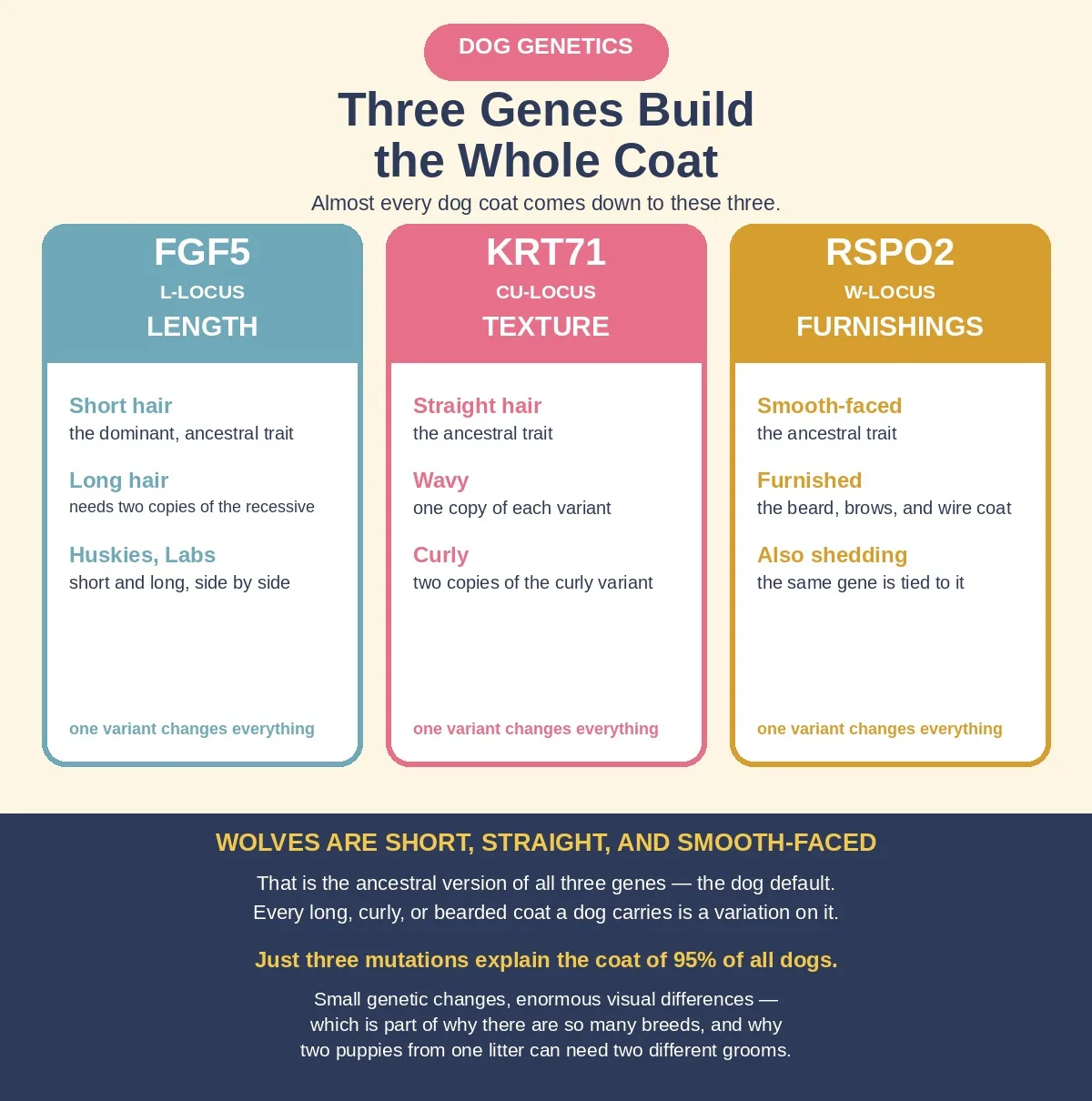
Researchers studying dog coats found that the variety boils down to three separate genetic questions:
- Is the hair long or short? Governed by a gene called FGF5, at what is known as the L-locus.
- Is the hair straight, wavy, or curly? Governed by KRT71, at the Cu-locus.
- Is the dog furnished or smooth-faced? Governed by RSPO2, at the W-locus. “Furnishings” are the long hairs on the face — the beard and the eyebrows you see on wire-haired breeds.
Three questions. Every combination of answers produces a different coat. The National Human Genome Research Institute puts it plainly: just three mutations, in various combinations, explain the coat types of about 95 percent of all dogs.
That is the part I find genuinely remarkable. We are not talking about hundreds of genes quietly adding up. We are talking about a handful of switches, flipped in different directions, producing everything from a Greyhound’s sleek coat to a Bichon’s cloud.
Wolves Are the Default Setting
Here is the fact that makes the whole thing click: your dog’s ancestors were short-haired, straight-haired, and smooth-faced.
That is what wolves are. For all three of those genes, the wolf carries what geneticists call the ancestral trait — the original version. Short. Straight. No beard.
So when you look at a dog with a long coat, you are looking at a variation. When you look at a curly coat, you are looking at a variation. Every one of those traits is a departure from the wolf blueprint, and each departure traces back to a specific change at one of those three spots.
How the Switches Actually Work
This is the part that explains why two puppies from the same litter can end up with completely different coats — which is something I see regularly in the van.
Every dog inherits two copies of each gene, one from each parent. For these coat genes, the ancestral version is usually dominant. That means a dog only needs one copy of the original version to show the original trait. To get the variation, a dog generally needs two copies of the changed version — one from each parent.
So for coat length:
- One or two copies of the ancestral version → short coat
- Two copies of the long-hair version → long coat
Same logic for texture. Straight is the ancestral trait. Curly needs two copies of the curly variant. And in between, a dog with one copy of each ends up wavy — not a blend, but its own distinct outcome.
You can see why two siblings from the same parents can diverge. If both parents carry one copy of each version, each puppy is drawing two cards from the same deck. One puppy can draw two long-hair cards and another can draw two short-hair cards. Same parents, same litter, entirely different grooming bills.
Where the Curls and the Beards Come From
A few specifics that are worth knowing, because they explain things you will notice on your own dog:
Curly coats come in more than one flavor. Researchers have identified a second variant at the same texture gene that produces curl in certain breeds. It shows up in Curly-Coated Retrievers, and also in Chesapeake Bay Retrievers, Lagotti Romagnoli, Poodles, and a few others. So “curly” is not one single genetic event — which is part of why one Doodle’s coat can behave so differently from another’s.
Hairlessness works differently in different breeds. In most hairless breeds — the Chinese Crested, Xoloitzcuintli, and Peruvian Inca Orchid — hairlessness is a dominant trait, but a lethal one when a dog inherits two copies. That is why those breeds cannot be bred hairless-to-hairless: every hairless dog has to carry one copy of the mutation and one normal copy. Interestingly, the American Hairless Terrier is hairless for a completely different reason — a recessive mutation — and those dogs are perfectly healthy with two copies.
Some coat traits travel with health considerations. This is where genetics stops being trivia and starts mattering. The ridgeback’s famous spinal ridge comes from a single dominant gene — and that same gene is associated with a higher risk of dermoid sinus, a defect where the skin can fail to close properly. Dogs with two copies of the ridge gene are at greater risk than dogs with one.
The One I Want Every Owner to Understand: Merle
If you take one thing from this post, make it this, because it is the one where genetics has real welfare consequences.
Merle — the mottled, blotchy pattern you see on Australian Shepherds, Catahoulas, and plenty of others — comes from a variant at the merle gene. It is semi-dominant: one copy produces the merle pattern you know. So every merle dog has one copy of the merle variant and one copy of the non-merle version.
Breed two merle dogs together and, on average, a quarter of the puppies will inherit two copies. Those are the “double merles,” and they usually do not look merle at all — they are mostly white.
That is where the problem is. The same cells that produce pigment also exist in the inner ear and the eye, and the merle mutation affects them. Dogs with two copies have a dramatically increased risk of deafness and eye abnormalities. The numbers vary by breed, and they are stark: in one study, roughly 10 percent of double-merle Catahoulas, about 56 percent of double-merle Australian Shepherds, and about 85 percent of the other double-merle dogs studied were deaf in both ears.
For comparison, a single-copy merle being deaf in both ears is under 1 percent. The risk is not spread evenly — it is concentrated in the double merle.
There is also a hidden version worth knowing about. In a dog with the right other genes, the merle pattern can be almost completely suppressed — the dog looks cream or solid, but still carries the merle variant and can still pass it on. That is why DNA testing matters before breeding a dog from a breed or family known to produce merle. A test tells you whether a dog carries zero, one, or two copies.
This is not a grooming issue and it is not something I can help with in the van. It is simply the clearest example of why the genetics behind a coat is worth understanding rather than just admiring.
What All of This Means in My Van
The reason I care about coat genetics professionally is that the coat is my whole job, and the genes explain the surprises.
When a mixed breed hops onto my table, I am not working from a breed manual. I am reading the actual coat in front of me — because the genetics did not consult a chart. A dog can inherit a Poodle’s curl and a Golden’s density in a combination that does not appear in any breed standard. Coat type is also tied to shedding: the same gene responsible for furnishings and wire coats is associated with the low-shedding trait, which is why Poodles tend to be light shedders while heavy-coated breeds carry the ancestral version.
So when you tell me your dog is “half this and half that,” I am listening, but I am mostly looking. The genes decide the coat. My job is to read what actually grew. If you want the practical version of that — what the three coat types need between grooms — I wrote a separate post on single, double, and wiry coats.
And if your two “identical” puppies need completely different grooming schedules for their entire lives — that is not a fluke, and it is not something you did. It is two cards drawn from the same deck.
Humanity over vanity — always.
New to Vroom Grooms?
If your dog needs regular grooming, the best way to get started is through the New Client Form. Use the note section for anything I should know — health conditions, behavioral quirks, coat preferences, or anything else I should be aware of before I pull into your driveway.
If you are already a current client and there is new information about your dog, text it to me directly. Anything that could affect the time or the grooming session needs to come in as soon as possible, or at least 48 hours before your appointment, in case I need to adjust my schedule or reschedule.
Ask me in person during your next appointment, or pop into my live stream on Twitch.tv/DogGroomerNIcole.
About the Author
Nicole is the owner and certified groomer behind Vroom Grooms LLC, a mobile dog grooming service serving Northwest Ohio. She specializes in double-coated breeds, anxious dogs, and clients who want honest, transparent grooming without the salon chaos. You can catch her live on Twitch at DogGroomerNIcole, where she streams real grooms and talks shop about the grooming world.
This post was drafted with help from Nagini 🐍, her digital assistant, who keeps the blog running, handles the tech side of the website, and makes sure Nicole spends more time with dogs and less time wrestling with WordPress.
Sources