Every dog owner has had this moment. You cleaned it up, you cleaned it well, and for a week or two everything smelled fine. Then the weather turned humid, or it rained, and that smell came drifting back out of the carpet like it had never left.
It is one of the most frustrating things about living with dogs, and most people end up deciding their carpet is just permanently ruined. It usually is not. But the reason it keeps coming back has almost nothing to do with how hard you scrubbed, and everything to do with chemistry.
The Stain Is Not the Problem
Here is the part that changes how you approach the whole job. When your dog has an accident on the carpet, the yellow mark you see is the least important part of it.
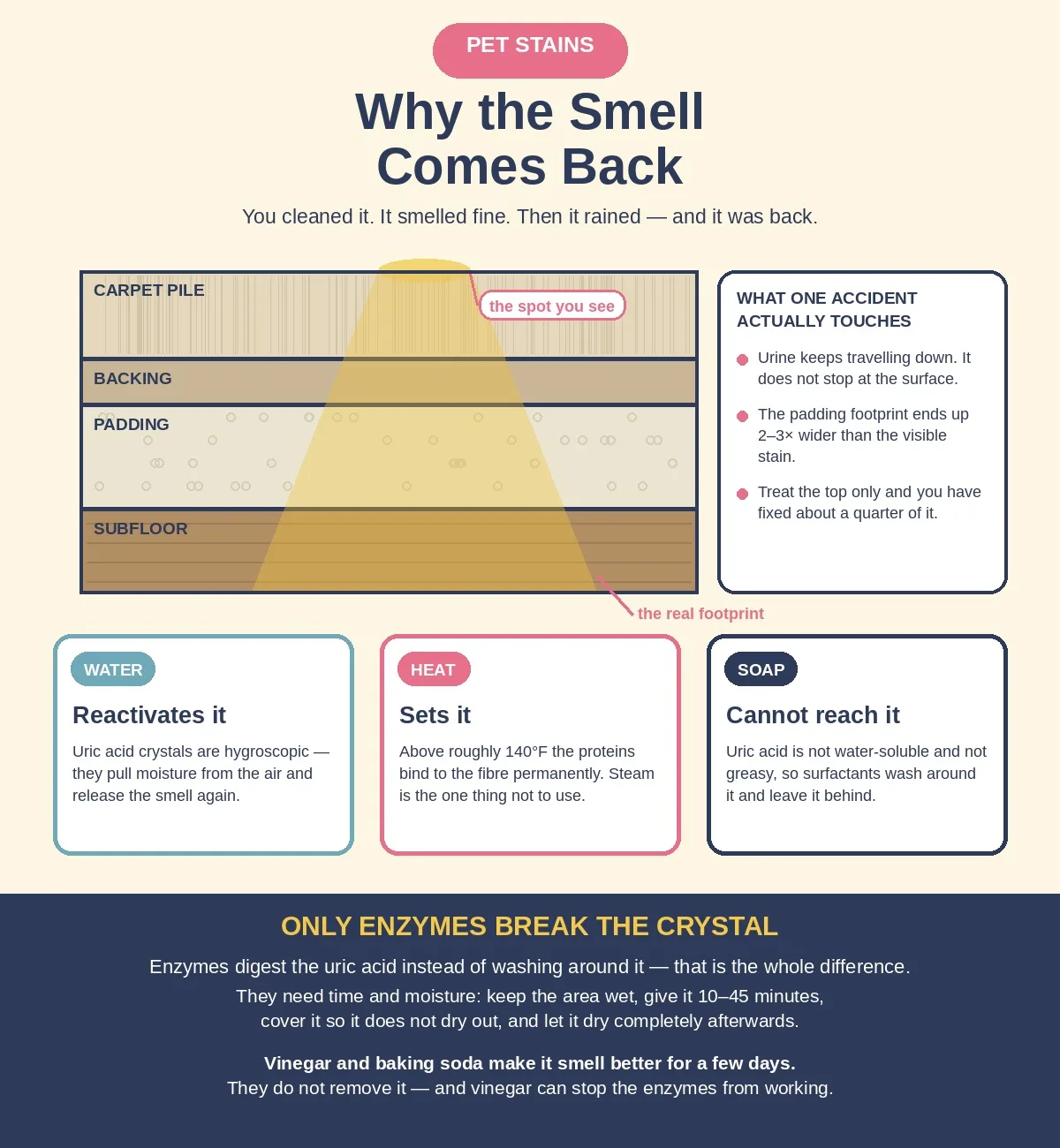
Urine is mostly water, and water soaks down. It does not sit politely on the surface of your carpet. It goes through the pile, through the backing, into the foam padding underneath, and in a bad enough accident it reaches the subfloor below that. And as it travels down, it spreads outward. So the contamination underneath your carpet is usually two to three times wider than the spot you can see on top.
If you treat only what is visible, you have cleaned roughly the top layer of a four-layer problem.
Why the Smell Comes Back
Once the water evaporates, what is left behind are uric acid crystals. They come from the urine, and they do something that no other stain in your house does: they bond to the carpet fibre and they do not dissolve in water.
That is the whole mystery in one sentence. Uric acid is not water-soluble. So when you clean with water, soap, or a rented carpet machine, you wash away the parts that do dissolve. The smell drops. You think you have won.
The crystals are still sitting there. And here is the trick they play: they are hygroscopic, which means they pull moisture straight out of the air. When the humidity climbs in the summer, or when you steam clean the carpet and re-wet the spot, those crystals rehydrate and start releasing the smell all over again.
That is why a spot can sit quietly all winter and reek every July. It is not your imagination and it is not a new accident. It is the original one, still there, waiting for moisture.
Three Things That Make It Worse
Heat. This is the big one, and it is the mistake I see most. Above roughly 140°F, urine proteins bind permanently to the fibre. Steam cleaning a pet stain before it has been properly treated does not clean it, it cooks it in, and it can make the stain genuinely impossible to remove. If you own a steam cleaner, keep it away from urine spots.
Extra water. Pouring water or cleaner on without a way to pull it back out just pushes the contamination deeper into the padding and closer to the subfloor. You are not rinsing it away, you are relocating it.
Soap. Regular carpet shampoo is built to dissolve grease and water-soluble soil. Uric acid crystals are neither, so the soap slips right past them. It might smell better for a few days. The crystals have not moved.
What Actually Works
There is exactly one category of product that breaks uric acid down instead of washing around it: enzymatic cleaners. Enzymes digest the uric acid molecule itself, turning it into compounds that simply evaporate. No crystals left means nothing left to reactivate.
But enzymes are living chemistry, and they have rules. This is where most people accidentally fail with them:
- Give it time. A spray-and-blot-after-two-minutes approach defeats the entire mechanism. Enzymes need to sit and work, often ten to forty-five minutes at minimum, and longer for old stains.
- Keep it wet. If the cleaner dries out before it finishes, the reaction stops. Saturating the spot and covering it with a damp towel and a sheet of plastic keeps it working.
- Go wider than the stain. Remember the funnel: the padding is contaminated well past the visible edge. Treat generously past the boundary.
- Do not use vinegar first. Vinegar is acidic and it can deactivate the enzymes you are about to apply. That is a real conflict, not a theory.
- Let it dry completely. A carpet that feels dry on top can still have a wet pad. Until the pad dries, you can still get odour. Give it a day or two, with airflow.
Fresh Accident vs Old Stain
If it is still wet: blot first, and blot a lot. Thick layer of paper towels, press down, stand on it, replace and repeat until you are not picking up more moisture. Then rinse with cool water and blot again. Cool, never warm. Once the bulk is out, apply the enzymatic cleaner and let it do its work.
If it has dried: you are dealing with set crystals, so the job is bigger. Rehydrate the area with cool water first, extract what you can, then apply the enzyme cleaner more generously, extend past the visible edge, and leave it much longer. Old stains frequently need two or three rounds. That is normal, not a sign you did it wrong.
Furniture and upholstery: same chemistry, more caution. Cushions and mattresses usually have foam inside, which soaks up urine like a sponge. Blot what you can, treat with enzyme cleaner, and if the foam core is saturated, be realistic — sometimes the filling has to go. Test any product on a hidden patch of fabric first, because not every cleaner is safe on every fibre.
About Vinegar and Baking Soda
I know these are the first things people reach for, and I understand why. They are cheap, they are in the cupboard, and they do make the room smell better.
But it is worth being straight with you: vinegar and baking soda do not remove uric acid crystals. Vinegar can neutralise the ammonia smell for a few days, and baking soda absorbs surface odour, but neither one destroys the crystal that is the actual source. And vinegar specifically can interfere with the enzyme cleaner that would have fixed it. If you are going to use enzymes, do not lead with vinegar.
When to Stop Cleaning and Call Someone
There is a point where no cleaning will fix it, and it is worth knowing where that line is. If a spot has been repeatedly soaked over months, the padding can be saturated past the point where any surface treatment reaches it. In that case the honest fix is lifting the carpet, replacing that section of pad, treating the subfloor, and relaying the carpet. It is not as expensive as replacing the whole carpet, and it actually solves it.
That is also the right call if the smell keeps returning after you have done everything correctly. It means the source is below where your cleaner can reach, and no amount of repeating the same process will change that.
The Part That Actually Matters
Here is why I care about this beyond the smell in your living room.
Dogs can smell urine at concentrations far below what we can detect. So if even a trace of that scent marker is left in the carpet, your dog can still read it, and it says to them: this is the spot. That is how a single accident becomes a habit, and how one patch of carpet becomes the bathroom.
Getting the odour out completely is not just about your house smelling nice. It is how you break the cycle.
And if a housetrained dog suddenly starts having accidents, especially more than once, please do not assume it is behaviour or spite. A urinary tract infection is a common cause, and so are incontinence, diabetes, and other conditions that get more likely with age — in older dogs it is often a weakening of the urethral muscles rather than anything behavioural. That is a vet conversation, not a cleaning one. A dog having accidents is frequently a dog who needs help.
The cleanup itself is not the only thing worth thinking about, either. If you are dealing with the aftermath of a dog who marks every vertical surface in the yard, that is a different problem with a different fix — I wrote about how urine damages outdoor surfaces separately. And for the everyday mess rather than the stain, there is getting dog hair off your floors.
New to Vroom Grooms?
If your dog needs regular grooming, the best way to get started is through the New Client Form. Use the note section for anything I should know — health conditions, behavioral quirks, coat preferences, or anything else I should be aware of before I pull into your driveway.
If you are already a current client and there is new information about your dog, text it to me directly. Anything that could affect the time or the grooming session needs to come in as soon as possible, or at least 48 hours before your appointment, in case I need to adjust my schedule or reschedule.
Ask me in person during your next appointment, or pop into my live stream on Twitch.tv/DogGroomerNIcole.
About the Author
Nicole is the owner and certified groomer behind Vroom Grooms LLC, a mobile dog grooming service serving Northwest Ohio. She specializes in double-coated breeds, anxious dogs, and clients who want honest, transparent grooming without the salon chaos. You can catch her live on Twitch at DogGroomerNIcole, where she streams real grooms and talks shop about the grooming world.
This post was drafted with help from Nagini 🐍, her digital assistant, who keeps the blog running, handles the tech side of the website, and makes sure Nicole spends more time with dogs and less time wrestling with WordPress.
Sources