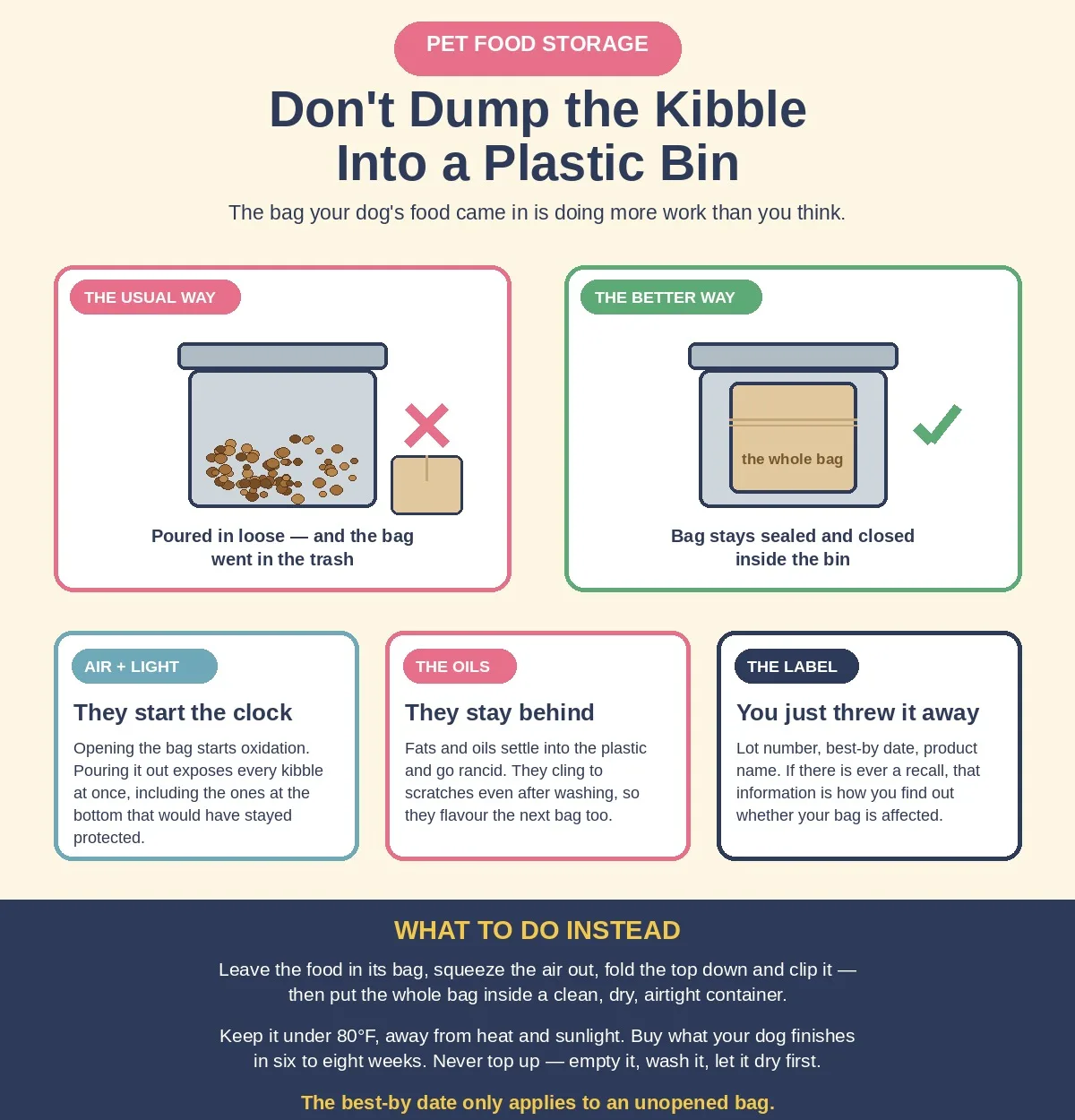
You buy the bag. You bring it home. You cut it open, pour the whole thing into a nice big plastic bin with a lid, and drop the empty bag in the trash. Everything looks tidy and organized on the shelf.
I understand the appeal completely. But that is the one thing I would ask you to stop doing, and the reasons are more interesting than you would expect. Only one of them is about the plastic itself.
The Bag Is Doing a Job
Here is what most people never think about. That bag is not just a bag. It is packaging that was engineered on purpose, and manufacturers spend real money testing how long their food stays good inside it. Many of the better ones are multi-layer constructions built to block the three things that ruin dry food: oxygen, light, and moisture.
When you pour the kibble into a bin, you throw that engineering in the trash along with the bag. And you do it in the most damaging way possible, because you expose every single kibble to air at once — including the ones down at the bottom that would have stayed sealed and protected for weeks longer.
Even a bag that is not airtight is better than a bin, because the food stays packed together with very little airspace around it. There is a reason the guidance from veterinarians keeps coming back to the same line: leave the food in its original packaging.
Oxidation Starts the Day You Open It
Kibble is sprayed with fats and oils, and those oils are what make it smell like food to your dog. They are also the first thing to go.
Oxidation is a chemical reaction with oxygen, and it is what causes food to go stale and lose nutrition over time. Opening the bag introduces air, and the clock starts running. Air and light are the enemies here — sunlight especially, and heat on top of that.
This is the part worth repeating: the best-by date on the bag applies to an unopened bag. The moment you cut it open, that date stops being a promise about your food.
Once those oils go rancid, the food does not just taste worse. It loses nutritional value, and a dog who suddenly refuses their dinner — or eats around a certain part of the bowl — may be telling you something about what is in it. Rancid food is not a dog being fussy. It is a dog being sensible.
The Oils Stay Behind in the Plastic
This is the plastic problem that has nothing to do with chemicals, and it is the one people never see coming.
Every scoop of kibble leaves a little fat and oil behind on the walls of the bin. Those residues settle into the plastic, and over time they go rancid right there on the surface. And plastic scratches. Every scoop, every wash, every wipe adds tiny grooves that hold onto that oil.
The result is that a well-used food bin starts to smell like old cooking oil no matter how many times you wash it — and that smell transfers onto the next bag of food. If you have ever wondered why your dog seems less excited about a fresh bag than they used to, this is worth considering. You are not just storing food. You are flavouring it with everything the bin has held before.
It also means the top-off habit is a real problem. Pouring new kibble on top of the last cup of old kibble means the new food is sitting on top of oils that are already going off, and the old food never leaves. Empty the container completely. Wash it. Let it dry fully before anything new goes in.
And You Just Threw Away the Label
This one matters more than people realize, and it is the reason the FDA and veterinary groups both say the same thing.
That bag carries the product name, the manufacturer, the best-by date, and — most importantly — the lot number. Pet food recalls are not rare events. Salmonella and other contamination show up in dry food, treats, and raw diets regularly enough that the AVMA maintains a running list of recalls and safety alerts going back years.
If there is ever a recall or an outbreak, the lot number is how you find out whether your food is one of the affected batches. Without the bag, you have a bin of anonymous brown kibble and no way to check. That is a genuinely bad position to be in, and it is why the recommendation is to keep the original packaging — or at minimum, cut out that panel of the bag and tape it to the outside of the container, refreshing it with every new bag.
So Is Plastic Itself the Problem?
Now the honest answer, because I do not want to overstate this.
Plastic as an outer container is fine. The guidance from veterinary sources is to store the original bag inside a clean, dry, airtight container — and that container can be plastic or stainless steel. So a bin is not the villain here. Dumping the food out of its packaging and into contact with that bin is the problem.
There is a separate question about chemicals, and I want to be straight with you about where the science stands. Some plastics contain substances like BPA, and PFAS compounds are used in food-contact packaging — including, per the AVMA, in pet food packaging. The AVMA notes that PFAS has been linked in animals to issues including liver damage and immune suppression, and that reducing exposure is the recommended approach since there is no treatment. Research is ongoing, and the effects of low-level exposure are still being worked out.
What I would not do is tell you a plastic food bin is poisoning your dog. That claim is stronger than the evidence supports. What I will say is this: if you can choose between plastic and stainless steel for the container your food lives in, stainless steel is the easier answer. It does not scratch the same way, it does not hold onto oils, and it does not have the chemical question attached to it at all.
What to Do Instead
The whole method fits in a few lines:
- Leave the food in its bag. Squeeze as much air out as you can, then fold the top down and secure it with a clip or tape. Less air above the kibble means slower oxidation.
- Put the whole bag in the bin. The bag goes in, the bag comes out, and the bin stays clean. You get the tidiness you wanted without losing the packaging barrier or the label.
- Keep it cool and dark. Under 80°F, out of sunlight, in a consistent spot. Not the garage or a shed, where heat and cold swings do their own damage.
- Buy what gets eaten. Around six to eight weeks of food is a good target for one bag. Buying giant bags to save money only works if your dog finishes them while they are still good.
- Never top up. Empty it, wash it with warm water and dish soap, let it dry completely, then refill. Do this every time you open a new bag.
- Store it off the floor to make life harder for pests, and keep it where your dog cannot help themselves.
And keep the food out of the kitchen if you can, along with washing bowls and scoops in hot soapy water somewhere other than the kitchen sink. Dry pet food can carry bacteria that make people sick, not just dogs, and cross-contamination with human food is a real risk — especially in households with young children or anyone immunocompromised.
If you are already rethinking what goes in the bowl, it is worth pairing this with how to tell whether your dog’s diet is actually working and a plain-English walkthrough of canine nutrition.
The Short Version
You do not have to buy anything fancy. You do not have to throw out the bin you already own. Just stop pouring the food out of its bag and throwing that bag away.
Keep the food in the packaging it was designed for, put the packaging in the bin, keep it cool and dark, and finish a bag while it is still fresh. That is the whole thing — and it protects your dog’s food, your dog’s dinner, and your ability to check the lot number if a recall ever lands on your brand.
New to Vroom Grooms?
If your dog needs regular grooming, the best way to get started is through the New Client Form. Use the note section for anything I should know — health conditions, behavioral quirks, coat preferences, or anything else I should be aware of before I pull into your driveway.
If you are already a current client and there is new information about your dog, text it to me directly. Anything that could affect the time or the grooming session needs to come in as soon as possible, or at least 48 hours before your appointment, in case I need to adjust my schedule or reschedule.
Ask me in person during your next appointment, or pop into my live stream on Twitch.tv/DogGroomerNIcole.
About the Author
Nicole is the owner and certified groomer behind Vroom Grooms LLC, a mobile dog grooming service serving Northwest Ohio. She specializes in double-coated breeds, anxious dogs, and clients who want honest, transparent grooming without the salon chaos. You can catch her live on Twitch at DogGroomerNIcole, where she streams real grooms and talks shop about the grooming world.
This post was drafted with help from Nagini 🐍, her digital assistant, who keeps the blog running, handles the tech side of the website, and makes sure Nicole spends more time with dogs and less time wrestling with WordPress.
Sources