Yesterday I wrote about everything your dog should not eat on Thanksgiving. Today is the other side of it, because “no” is not very useful on its own and a dog watching a house full of people eat is a dog who is going to get something eventually.
You are better off deciding in advance what that something is.
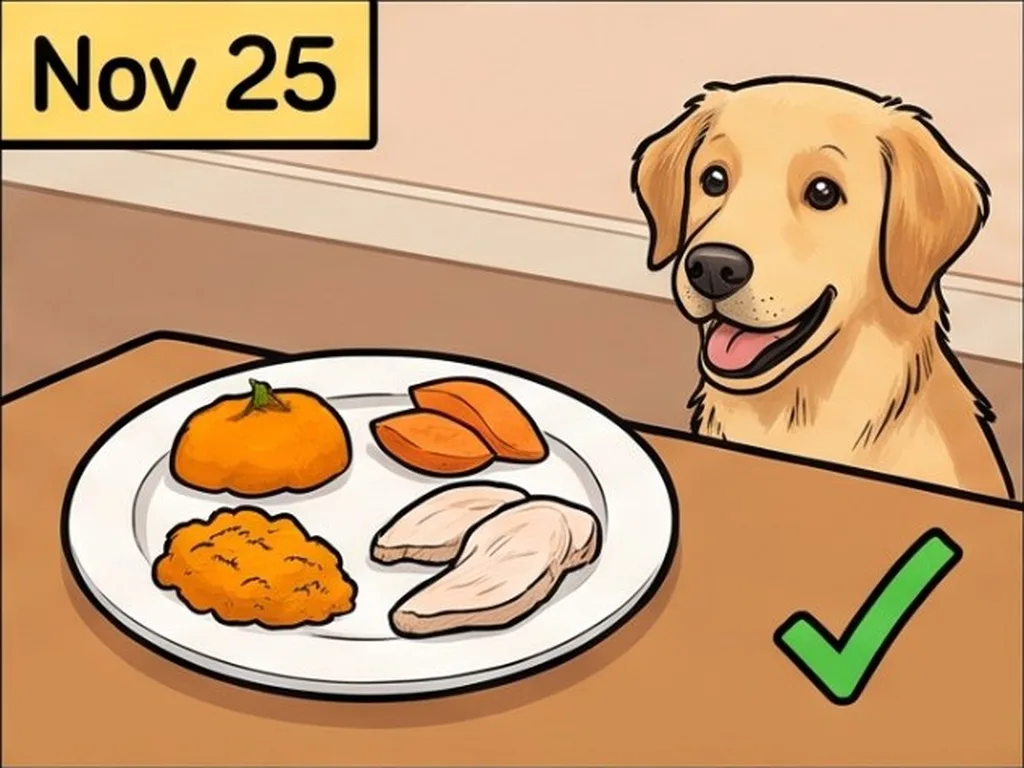
The Rule That Makes This Simple
Plain, unseasoned, unbuttered, and small.
That is the whole filter. If a food passes all four, it is probably fine. If it fails any one of them, it does not go to the dog. Everything on the safe list below is safe because of that rule, not in spite of it.
The Safe List
Plain cooked turkey breast. White meat, no skin, no bone, no seasoning, no gravy, no butter. Cooked plain and diced into small pieces. This is the safest thing on the table and the easiest to hand out deliberately instead of having it fall on the floor.
Plain green beans. Cooked or raw, no salt, no butter, no casserole, no fried onions on top. A genuinely useful treat because the volume is satisfying and the calories are low.
Plain pumpkin purée. Plain pumpkin, not pumpkin pie filling. Those are two completely different products and the pie filling has sugar and often spice. A spoonful of plain purée is a common and gentle addition to a dog’s food.
Plain sweet potato. Cooked, no butter, no brown sugar, no marshmallow. Small pieces.
A little plain carrot. Raw or cooked, no seasoning. Good crunch, low value.
A small amount of plain cooked white rice or plain cooked oatmeal if your dog already eats it routinely. Not as a Thanksgiving novelty — as a thing their system already knows.
The Portion Rule
Every one of these is safe in the same way that a normal dinner is safe. None of them are safe in the quantity that a house full of people can deliver over six hours.
A useful ceiling: the treats and extras together should be a small fraction of the day’s calories. In practice that is a few small pieces, not a plate. And if your dog is getting a real piece of turkey, that is a meal’s worth of protein — adjust the actual dinner accordingly rather than adding it on top.
The reason this matters is not calorie counting for its own sake. It is that a dog can get diarrhoea from too much of a good thing just as easily as from the wrong thing, and a dog with an upset stomach on a holiday is miserable and inconvenient in equal measure.
What “Plain” Actually Means
People hear “plain turkey is fine” and then hand over a piece that was brined, basted, rubbed, or sitting in a pan of drippings. That is not plain.
Brine means salt. Basting means butter or oil. Rubs mean garlic powder, onion powder, paprika, and salt. Pan drippings mean fat. Any of those takes a safe food off the safe list.
If you want to give your dog turkey, the reliable move is to set aside a plain piece before the bird goes into the oven or before it gets basted. Cook it separately, or just accept that the turkey on the table is not for the dog this year.
The Two-Item Plate
If you want the dog to feel included — and it is fine to want that — build a small plate rather than letting people hand things down one at a time.
Plain turkey, plain green beans, a spoon of plain pumpkin. In a bowl, in their normal spot, at their normal time, away from the table. That is a Thanksgiving for a dog. It is also controlled, countable, and something you decided rather than something that happened to them.
What you are avoiding is the drip-feed: a piece from an aunt, a bit of roll from a cousin, a scrap from a plate being cleared. That is how a dog ends up eating six things nobody can account for, and when the vomiting starts that evening, nobody can tell the vet what is in the dog.
One Thing to Be Honest About
Some dogs genuinely cannot have any of this. If your dog has a diagnosed food allergy, a history of pancreatitis, inflammatory bowel disease, or is on a prescription diet, the safe list is not safe for them. Their normal food is the safe list.
I am not a veterinarian and this list is not a prescription. It is the general guidance for a healthy dog with a normal digestive system. Your vet knows your dog’s history and I do not.
The Leftover Trap
The meal is not the only risk. The three days after it are.
A fridge full of leftovers means a fridge full of reachable food, and a house full of visiting relatives means a house full of people who do not know the rules. The dog who got nothing on Thursday can absolutely get into the turkey container on Saturday while somebody is loading the dishwasher.
Two things fix most of it. Put leftovers away in containers with lids and put them high, not on a low shelf where a determined dog can reach the edge. And when the visitors leave, do a sweep of the kitchen from the dog’s eye level — the floor, the low surfaces, the trash that got moved to the garage and then moved back.
The same list applies. No bones in the trash bag left by the door. No drippings in a pan on the counter. The danger does not end when the plates are cleared.
The Wrap
Plain, unseasoned, unbuttered, small. Plain turkey, green beans, pumpkin, sweet potato, carrot. Decide what the dog gets before the meal starts, put it in a bowl, and keep it away from the table.
Including your dog is a nice instinct. Doing it deliberately instead of accidentally is what keeps the evening boring — and boring is exactly what you want from a holiday with a dog in the house. 🍂
About the Author
Nicole is the owner and certified groomer behind Vroom Grooms LLC, a mobile dog grooming service serving Northwest Ohio. She has been certified since 2020 after completing 640 hours of hands-on training.
This post was drafted with help from Nagini 🐍, her digital assistant, who keeps the blog running, handles the tech side of the website, and makes sure Nicole spends more time with dogs and less time wrestling with WordPress.
Sources