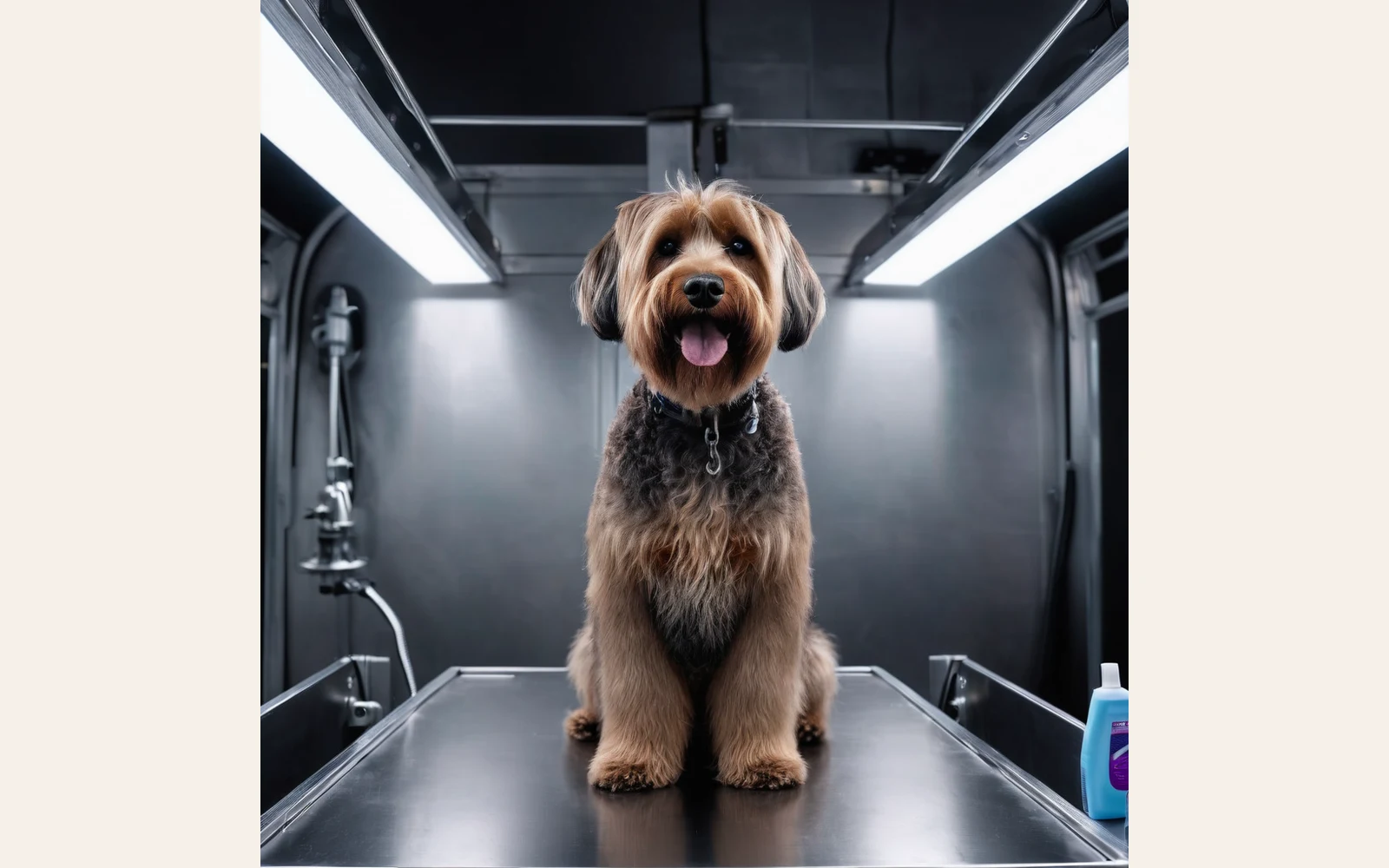
Not every service you see on a groomer’s menu belongs on a groomer’s menu. Some of it is our job. Some of it is a vet’s job. The line gets blurry because dogs are dogs, and owners want one trusted person to handle everything. I get that. But knowing the difference is one of the best things you can do for your dog, and it is one of the main reasons I built Vroom Grooms the way I built it.
Here is the breakdown, and where Vroom Grooms fits.
What a Groomer Is Actually Trained For
Dog grooming is a separate trade from veterinary medicine. The schooling, the certifications, the daily repetition — it all points toward coat, skin, nails, ears, and hygiene. A good groomer spends thousands of hours learning how to safely handle live dogs with sharp tools, hot dryers, and loud equipment, all while reading body language, recognizing stress, and keeping everyone in the room safe.
When I went through training, the bulk of my 640 hours was spent on:
- Bathing, drying, and brushing every coat type under the sun
- Clipper work, scissor work, and breed-specific styling
- Skin and coat health — what is normal, what is suspicious, what to flag
- Nail anatomy and safe trimming techniques
- Ear anatomy, ear cleaning, and the safe way to handle ear plucking
- Sanitary hygiene trims
- Behavior, restraint, and stress reduction
That last one matters more than most people think. A groomer who cannot read a stressed dog is a danger to the dog and to themselves. Mobile grooming adds a whole extra layer: I am the driver, the setup crew, the cleanup crew, and the sole handler. There is no one else in the van to help me. I have to be good at every part of it.
The Services a Groomer Should Be Offering
A standard full groom at a legitimate operation should include a bath, a blow dry, a nail trim with filing, ear cleaning, a haircut (or a brushout / de-shed depending on coat), teeth brushing, and anal gland expression when needed. Some of these are optional add-ons, some are core. Here is how I break it down at Vroom Grooms.
🛁 Core Full Groom
The full groom is the bread and butter. For a short-haired dog, that means a de-shed and a tidy-up. For a long-haired or curly-coated dog, it means a full bath, blow dry, brushout, and either a trim or a breed-style cut. The point of the full groom is to get the coat clean, get the dead hair out, and leave the dog comfortable.
Pricing for a full groom depends on coat length, size, and condition. Short-haired dogs run $75 to $105, long and fluffy dogs run $90 to $190, and doodles, poodles, and curly coats run $100 to $205. Those are starting prices, and the total can climb with the matted dog fee (+$50), the difficult dog fee (+$50 in extreme cases), or the overtime fee (+$50 for every 20 to 30 minutes over the 2-hour window). I always quote the full cost up front because the last thing I want is for an owner to be surprised at the door.
💅 Add-Ons That Are Genuinely Groomer Work
A $10 add-on at Vroom Grooms covers the small things that take a real skill to do well. Nail trim and grind, ear cleaning, teeth brushing with a dog-safe enzymatic toothpaste, paw pad shave, sanitary trim, eye and mouth corner cleanup, and even nail polish for the dogs who tolerate it. None of these require a vet. They require a steady hand and a dog who has been desensitized to the process.
If your dog needs any of these as a one-off and not part of a full groom, the $50 mobile service fee applies on top of the $10 add-on. A nail trim is $10 plus the $50 mobile fee, so $60 total. That is the full cost. I am not a fan of hidden fees, and I never will be.
👂 Ear Plucking (When It Is Actually Needed)
This is the one that gets misunderstood. I only pluck ears when there is actual hair in the canal that needs to come out. I do not pluck ears just because the breed is on a list. If your dog’s ear canal is clean and healthy, I leave it alone. If there is hair that traps moisture, debris, and bacteria, I pluck it. This is grooming work. It is hygiene work. It is not a vet procedure.
One important exception: I do not pluck compact ears. Compact ear canals are tight, warm, and poorly ventilated, which is exactly the kind of environment where infections start. Leaving the hair in place on a compact ear is sometimes the only thing giving the owner a heads-up that something is brewing. Pull that hair out and an early infection can quietly settle in and get worse before anyone notices. So if your dog has compact ears, I leave them alone and I tell you what I see. That is one of the small ways grooming and vet care have to work together instead of stepping on each other.
The Services That Belong at the Vet
A good groomer knows when to stop and send you to the vet. I flag concerns at almost every appointment, and I have sent more dogs to the vet than I can count. The following things are not groomer work, and a groomer who offers them is either overconfident, under-trained, or skirting regulations.
Diagnosing skin conditions. I can tell you your dog’s skin looks inflamed, flaky, or infected. I cannot tell you why. The why needs a vet. If I see a hot spot, a rash, hair loss, weird pigmentation, or a smell that does not wash out, I tell you to book a vet appointment before I do anything else.
Treating ear infections. I clean ears. I do not treat infections. If the ear is red, swollen, hot, or has a yeasty or foul smell, I will not clean it. I will send you to the vet. Putting a tool or ear cleaner into an infected ear canal can make it worse.
Vaccinations. Vaccines are vet territory, full stop. As of January 1, 2026, Vroom Grooms requires proof of Rabies, DHPP, and Bordetella on file before the appointment, and I keep the records on the client side through the Current Client page in the bottom navigation. The records are the owner’s responsibility to maintain. I do not chase people down for them.
Bloodwork, dental extractions, mass removals, anything involving anesthesia. Not a groomer service. Never will be.
Severe matting that requires sedation. I do not de-mat. Mats are not brushed out, they are not picked apart, and they are not worked through with detangler. I cut them or I shave them off — that is the only way to handle them safely and humanely. If a dog is so matted that the only option is to sedate them and shave them under medical supervision, that is a vet job. My job is to get the coat back to a maintainable condition with a shave-down under the brand rule I call Humanity over Vanity. A shaved coat grows back. A stressed dog who fights clippers while I am trying to dig mats out of their skin can get hurt. I will always choose the dog over the coat.
Anything that requires a diagnosis. If a dog is limping, lethargic, not eating, vomiting, or just acting off, I am not the one to call. I am the one who notices because I see your dog more often than your vet does, and I will absolutely tell you when something looks wrong. Then I send you to the vet.
Why the Mobile Setup Makes the Line Easier to Hold
Most of my clients see me every 4 to 8 weeks. That is more frequent contact than most people have with their vet, especially for healthy adult dogs. I get to know what is normal for your dog. I notice when the coat texture changes, when the breath gets worse, when a new bump shows up behind the ear, when the eyes look gunky. I am not diagnosing, but I am watching, and I tell you what I see.
The mobile setup also makes the actual grooming calmer, which means I can spot things a shop groomer might miss. A dog in a busy salon with five other barking dogs is in fight-or-flight the whole time. A dog in a quiet van with one handler is a dog whose body is showing you what is actually going on. That is a huge part of why I do this.
How to Tell If Your Groomer Knows the Line
A few quick checks:
- Do they have formal training and continuing education, and can they actually tell you what they learned from it?
- Do they refer out when something is over their head, or do they try to handle it themselves?
- Do they know their products, their tools, and the reason behind every step?
- Do they keep your dog’s vaccination records on file and ask for updates?
- Do they tell you what they found during the groom, in plain language, without diagnosing?
If the answer to most of those is yes, you are in the right place. If your groomer is diagnosing skin conditions, offering to draw blood, or selling you prescription products, that is a red flag.
🐾 The Wrap
A groomer’s job is coat, skin, nails, ears, and hygiene. A vet’s job is everything medical. The two work best when they stay in their lane and communicate well. I do the grooming. I watch your dog like a hawk. I tell you what I see. When something is outside my lane, I send you to the vet. That is the deal, and it is the deal I have kept for every dog on my route.
If you want to see what a real appointment looks like, head over to vroomgrooms.com and click the Live button. We stream real appointments every week on Twitch at DogGroomerNicole. Real grooming, real dogs, real community. We do not stage the dogs. We do not fake the results. If a dog is having a rough day, you will see that too. That is the whole point.
Ready to book a clean, calm spa day for your pup? Fill out the New Client Form and let us get you on the schedule.
Stay fresh and furry,
Nicole / Vroom Grooms LLC