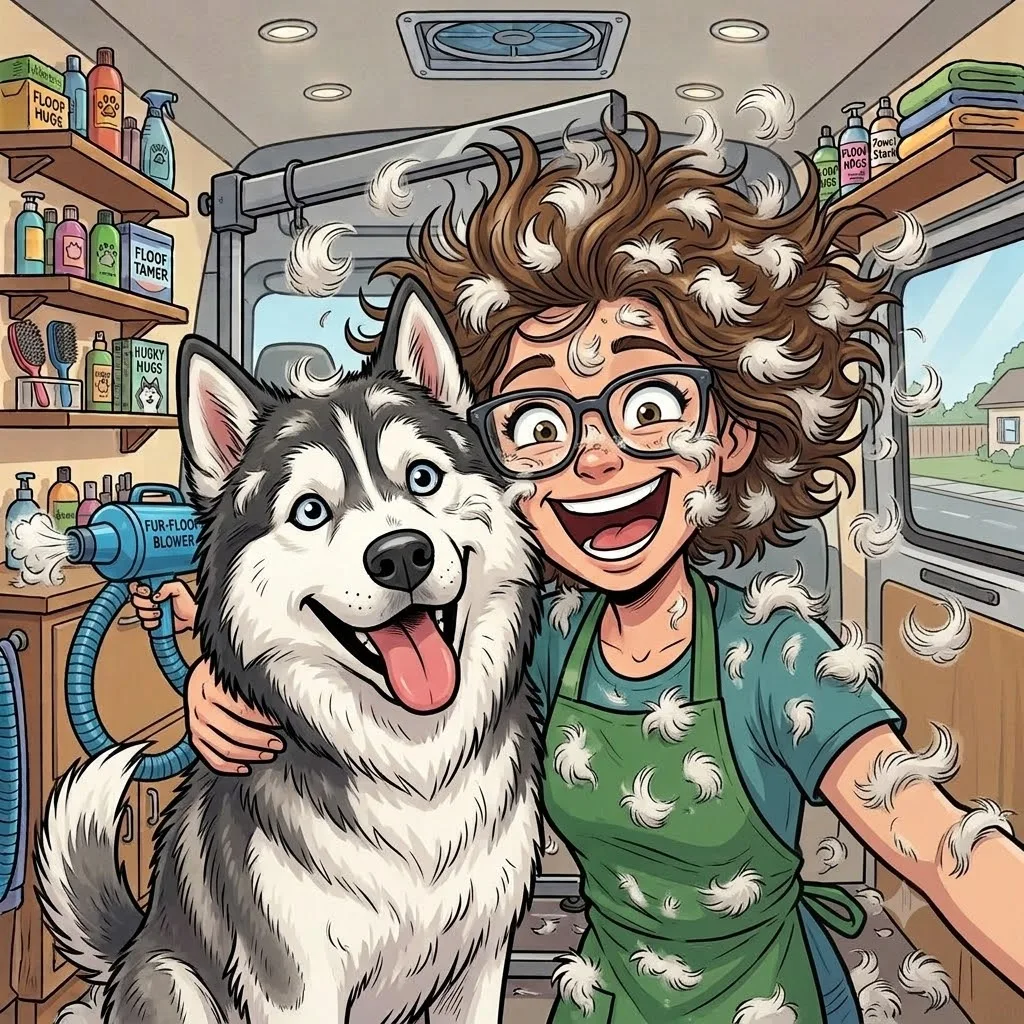
Twice a year, my phone blows up. The requests are all the same: “Can you de-shed my dog? I am drowning in fur.” And twice a year, I have the same conversation with every client: here is what de-shedding actually is, here is what it can and cannot do, and here is how to manage shedding season without losing your mind.
First, the Bad News
All dogs shed. Some shed more than others, but they all shed. The amount of hair a dog leaves around your house is determined by genetics, coat type, season, health, and diet. No groomer, no product, no magic tool can stop a dog from shedding. What we can do is reduce the amount of loose hair that ends up on your furniture, and we can do it in a way that is healthier for the dog’s coat and skin.
If anyone promises you a “shed-proof” dog or a “no-shed” treatment, they are not being honest. Run.
What De-Shedding Actually Is
A de-shedding treatment is a multi-step process designed to remove the loose, dead undercoat from a double-coated dog. The process usually includes:
– A bath with a de-shedding shampoo (formulated to loosen the undercoat)
– A conditioner that helps the undercoat release
– A high-velocity dryer that blows out a significant amount of loose undercoat
– A thorough brush-out with an undercoat rake and de-shedding tool
– A final brush and comb to make sure nothing is left behind
The result is a dog with significantly less loose undercoat, which means less hair on your couch, less hair on your clothes, and a more comfortable dog. It does not mean the dog will not shed at all. They will still shed. They will just shed less, for a few weeks.
Which Dogs Benefit
De-shedding treatments are most effective on double-coated breeds with a thick undercoat. Think:
– Huskies and Malamutes
– Golden Retrievers and Labrador Retrievers
– German Shepherds
– Bernese Mountain Dogs
– Australian Shepherds
– Border Collies
– Shetland Sheepdogs
– Akitas
– Chow Chows
– Pomeranians (the undercoat is smaller but it is there)
Single-coated breeds (Poodles, Bichons, Yorkies, Maltese) do not have an undercoat and do not need de-shedding. Short-coated single-layer breeds (Pit Bulls, Beagles, Boxers) do shed, but a de-shedding treatment is less effective because there is less undercoat to remove. A good brush and a bath help, but the dramatic before-and-after of a Husky de-shed is not going to happen with a Pit Bull.
The Seasonal Cycle
Double-coated dogs typically blow their coat twice a year: in spring, when they lose the winter undercoat, and in fall, when they lose the summer undercoat and grow in the winter coat. The spring blow is usually the more dramatic one, and it can last 4 to 6 weeks. During this time, regular brushing and a professional de-shed can make a huge difference.
Outside of the seasonal blows, double-coated dogs shed year-round, just less dramatically. A de-shed treatment every 6 to 8 weeks keeps the undercoat under control.
The Tools That Actually Work
Not all de-shedding tools are created equal. Here is what works and what does not:
Undercoat rake. The workhorse. A good rake with long teeth that reach through the topcoat and pull out the undercoat. Get one with a comfortable handle and teeth that are not sharp.
Slicker brush. Good for the outer layer and for getting out the smaller tangles. Not the main de-shed tool, but a great follow-up after the rake.
De-shedding tool (FURminator-style). Effective but easy to overuse. The blade is sharp, and if you press too hard or use it too often, you can damage the topcoat. Use sparingly, especially during the seasonal blow when the undercoat is releasing naturally.
High-velocity dryer. The single most effective de-shedding tool. The force of the air blows out loose undercoat that no brush can reach. This is what makes the dramatic before-and-after possible.
Comb. The comb does not lie. After de-shedding, comb through the coat. If the comb goes through easily, the undercoat is clear. If it snags, there is more work to do.
What De-Shedding Does NOT Do
– It does not stop shedding
– It does not change the dog’s coat texture or color
– It does not prevent matting (in fact, matting is a separate issue that needs to be addressed before de-shedding)
– It does not replace regular brushing between sessions
– It does not work on single-coated breeds
– It does not work on short-coated single-layer breeds in any dramatic way
The Grooming Connection
De-shedding is one of the most common services I provide, and it is one of the most satisfying. The amount of fur that comes off a Husky or a Golden during a proper de-shed is genuinely shocking. I have filled entire garbage bags with undercoat from a single dog.
If you have a double-coated dog and you are tired of the fur, talk to me about a de-shed schedule. Most double-coated dogs do well with a de-shed every 6 to 8 weeks, with weekly at-home brushing in between. That routine will keep your house significantly cleaner and your dog significantly more comfortable.
Stay fresh and furry, Nicole / Vroom Grooms LLC
About the Author
Nicole is the owner and certified groomer behind Vroom Grooms LLC, a mobile dog grooming service serving Northwest Ohio. She has been certified since 2020 after completing 640 hours of hands-on training, and de-sheds dozens of double-coated dogs every year. You can catch her live on Twitch at DogGroomerNIcole, where she streams real appointments and shows the dramatic before-and-after of a good de-shed.
This post was drafted with help from Nagini 🐍, her digital assistant, who keeps the blog running, handles the tech side of the website, and makes sure Nicole spends more time with dogs and less time wrestling with WordPress.