There is a brown crust that builds up on some dogs’ teeth, and almost everybody calls it the same thing: tartar. That part is correct. What surprises most people is learning that the crust did not start out hard — and that the difference between the two stages is the whole reason dental care works the way it does.
Your dog’s mouth makes both of them. One is a soft film. One is a hard, cement-like deposit. A toothbrush can deal with the first and cannot touch the second. Knowing which is which changes what you do at home and when you need the vet.
The Soft Layer: Plaque
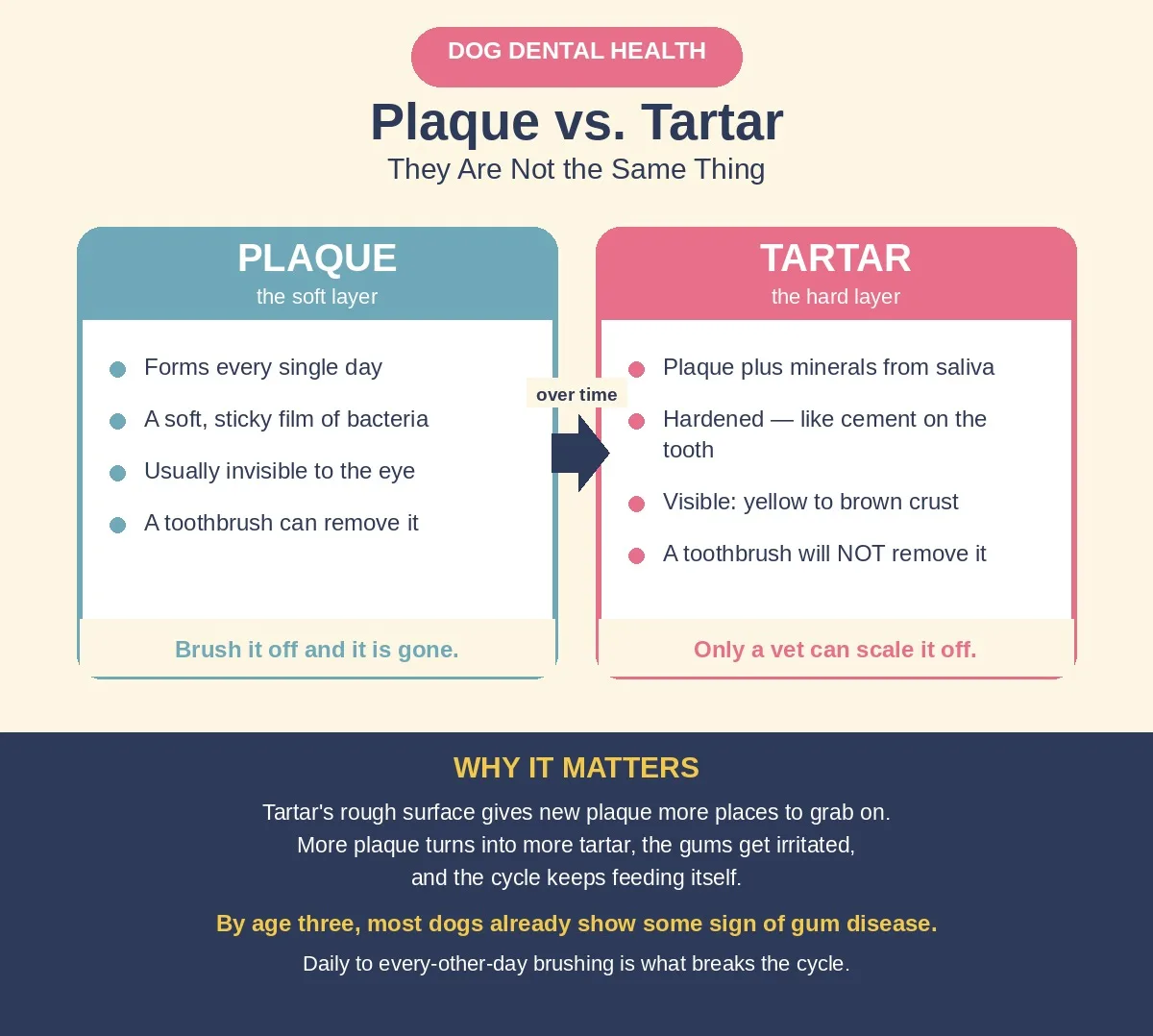
Plaque forms every single day. It is a soft, sticky film of bacteria that coats the surface of the teeth, both above and below the gum line. It is produced by the bacteria that normally live in a dog’s mouth — it is not a sign that anything has gone wrong, and it is not something you can prevent from forming. It just happens, the same way it happens in your own mouth.
Here is the frustrating part: plaque is usually invisible. You cannot look at your dog’s teeth and see the plaque. So the mouth can be well on its way to trouble while everything still looks fine from the outside.
The good news is that plaque is soft. A toothbrush removes it. That is the entire reason brushing matters — you are not polishing the teeth, you are breaking up a film before it has a chance to set.
The Hard Layer: Tartar
Tartar is what plaque becomes.
When plaque sits on the tooth long enough, minerals in your dog’s saliva — calcium salts, specifically — get deposited on top of it. That is the transformation. The soft film picks up minerals and hardens into a rough, crusty deposit that bonds to the tooth surface. At that point it is no longer a film sitting on the tooth. It is part of the tooth’s surface.
Tartar is the thing you can actually see: the yellow-to-brown buildup along the gum line and on the back teeth. If you have ever noticed that crust and wondered how long it had been there, the answer is usually “a while.” It takes time for plaque to mineralize.
And this is the part that matters most: a toothbrush will not remove tartar. Not with more effort, not with a different brush, not with a longer session. Once it has hardened, brushing is the wrong tool. Tartar has to be scaled off, and that is a job for your veterinarian.
Why the Cycle Keeps Feeding Itself
Here is why this is worth understanding rather than just knowing the vocabulary word.
Tartar is rough. Plaque is sticky. Put those two facts together and you get a loop: the rough surface of existing tartar gives new plaque more places to grab on and build up, which means more plaque in that spot, which means more of it mineralizes into more tartar. The rougher it gets, the faster it collects.
Meanwhile the gums are reacting to the plaque sitting along the gum line. That reaction is inflammation, and left alone it turns into gum disease — which is progressive. It does not plateau. It keeps going.
The numbers on this are worth sitting with: by age three, most dogs already show some sign of gum disease. It is one of the most common things vets see, and most owners have no idea it is happening, because a dog with a sore mouth usually keeps eating and keeps acting normal. Dogs are very good at not showing pain.
What You Can Fix and What You Cannot
This is the practical split, and it follows directly from the two stages.
Plaque is yours. Because it is soft and forms daily, the fix is mechanical and frequent: brushing. The guidance from veterinary sources is brushing every day to every other day. Less often than that does not accomplish a whole lot — you are removing a film that has already started hardening. If daily is genuinely not possible for your dog, the next best thing is to work two or three different products that clean teeth in different ways, such as dental chews, water additives, or tooth wipes, and rotate them daily.
Tartar is not. Once it has bonded to the tooth, at-home tools are not going to take it off, and the deep cleaning that does remove it — scaling and polishing, including below the gum line — has to be done by a vet under anesthesia. A toothbrush cannot reach below the gum line, and the tartar that matters most is often exactly there.
Some breeds and sizes need more attention than others. Small dogs and dogs fed wet food tend to be at higher risk. Your vet can tell you whether your dog is on an annual schedule or should be checked twice a year.
What This Looks Like in My Van
Dental care is part of a Vroom Grooms full groom, and I want to be precise about what that means, because there is a real difference between what I do and what your vet does.
Every full groom includes basic dental care. Depending on how well your dog tolerates it and what shape their teeth are in, that is either a brushing with dog-safe toothpaste or an application of dental spray. As an individual service, teeth brushing and dental spray is $10, plus the $50 mobile service fee.
That is not a deep dental cleaning. I am not scaling tartar and I am not getting below the gum line — I cannot, and no groomer should be claiming to. What I am doing is a maintenance step: freshening the mouth, keeping the surface in better shape between professional cleanings, and getting a look at what is going on in there.
Which is actually the underrated part. I look inside a lot of mouths, and the dogs whose owners brush come in with pink gums and breath that does not announce itself. The dogs who do not come in with the brown crust. If I notice something that looks like more than a grooming problem, I will tell you — but I will be telling you to call your vet, not to book another groom.
What Should Make You Pick Up the Phone
The reason I keep saying “call your vet” is that some things are past the point where home care helps, and cleaning an already irritated mouth can make it worse.
Watch for:
- Bad breath that has gotten noticeably worse
- Yellow or brown buildup along the gum line
- Gums that look red, swollen, or inflamed — healthy gums are firm and pink
- Drooling more than usual
- Pawing at the mouth or rubbing their face
- Chewing on one side, dropping food, or avoiding hard treats and toys they used to love
- Loose teeth, or anything that looks like an abscess
Any of those are a vet conversation, not a brushing problem. Mouth infections can spread beyond the mouth — the bacteria involved can affect the heart, liver, and kidneys — which is why vets take dental disease seriously and why “he still eats fine” is not the reassurance it feels like.
One Thing to Never Do
Never use human toothpaste on your dog. This one is not a preference, it is a safety issue. Human toothpaste is designed to be spit out, and your dog cannot spit — they swallow it. The fluoride and the sweeteners are the problem, and some human toothpastes contain xylitol, which is toxic to dogs.
Use toothpaste made for dogs. It comes in flavors they consider food, which is most of the battle.
The Short Version
Plaque is soft, forms daily, and is invisible. Tartar is plaque that has picked up minerals from saliva and hardened onto the tooth. You can remove the first with a brush. Only your vet can remove the second.
That is why the routine works the way it does: you handle the soft layer often enough that it never gets the chance to become the hard one, and your vet handles the hard layer when it is already there.
If you want the practical side — how to actually build a brushing habit your dog will tolerate — I wrote a separate post on making the brushing habit stick. The mechanism is the easy part. The habit is the work.
Humanity over vanity — always.
New to Vroom Grooms?
If your dog needs regular grooming, the best way to get started is through the New Client Form. Use the note section for anything I should know — health conditions, behavioral quirks, coat preferences, or anything else I should be aware of before I pull into your driveway.
If you are already a current client and there is new information about your dog, text it to me directly. Anything that could affect the time or the grooming session needs to come in as soon as possible, or at least 48 hours before your appointment, in case I need to adjust my schedule or reschedule.
Ask me in person during your next appointment, or pop into my live stream on Twitch.tv/DogGroomerNIcole.
About the Author
Nicole is the owner and certified groomer behind Vroom Grooms LLC, a mobile dog grooming service serving Northwest Ohio. She specializes in double-coated breeds, anxious dogs, and clients who want honest, transparent grooming without the salon chaos. You can catch her live on Twitch at DogGroomerNIcole, where she streams real grooms and talks shop about the grooming world.
This post was drafted with help from Nagini 🐍, her digital assistant, who keeps the blog running, handles the tech side of the website, and makes sure Nicole spends more time with dogs and less time wrestling with WordPress.
Sources
- AKC — Everything You Need to Know About Periodontal Disease in Dogs
- AKC — How to Brush Your Dog’s Teeth and Why It’s So Important
- AKC — Do Dogs Need Dental Care? Dog Myths Debunked
- AKC — Dog Dental Examinations Can Prevent Tooth and Gum Pain
- AVMA — American Veterinary Medical Association, companion animal dental health