Somebody asks me about this almost every week, and it is always the same two questions. Are his eyes really blue, or will they change? And then, later: is that rare?
Eye color is the kind of thing we look at every single day without ever asking how it works. But the answer is genuinely interesting, and it explains something you have probably noticed without knowing why — that almost every puppy you have ever met has blue eyes.
There Is No Such Thing as Blue Pigment
Start here, because this is the part that surprises people most.
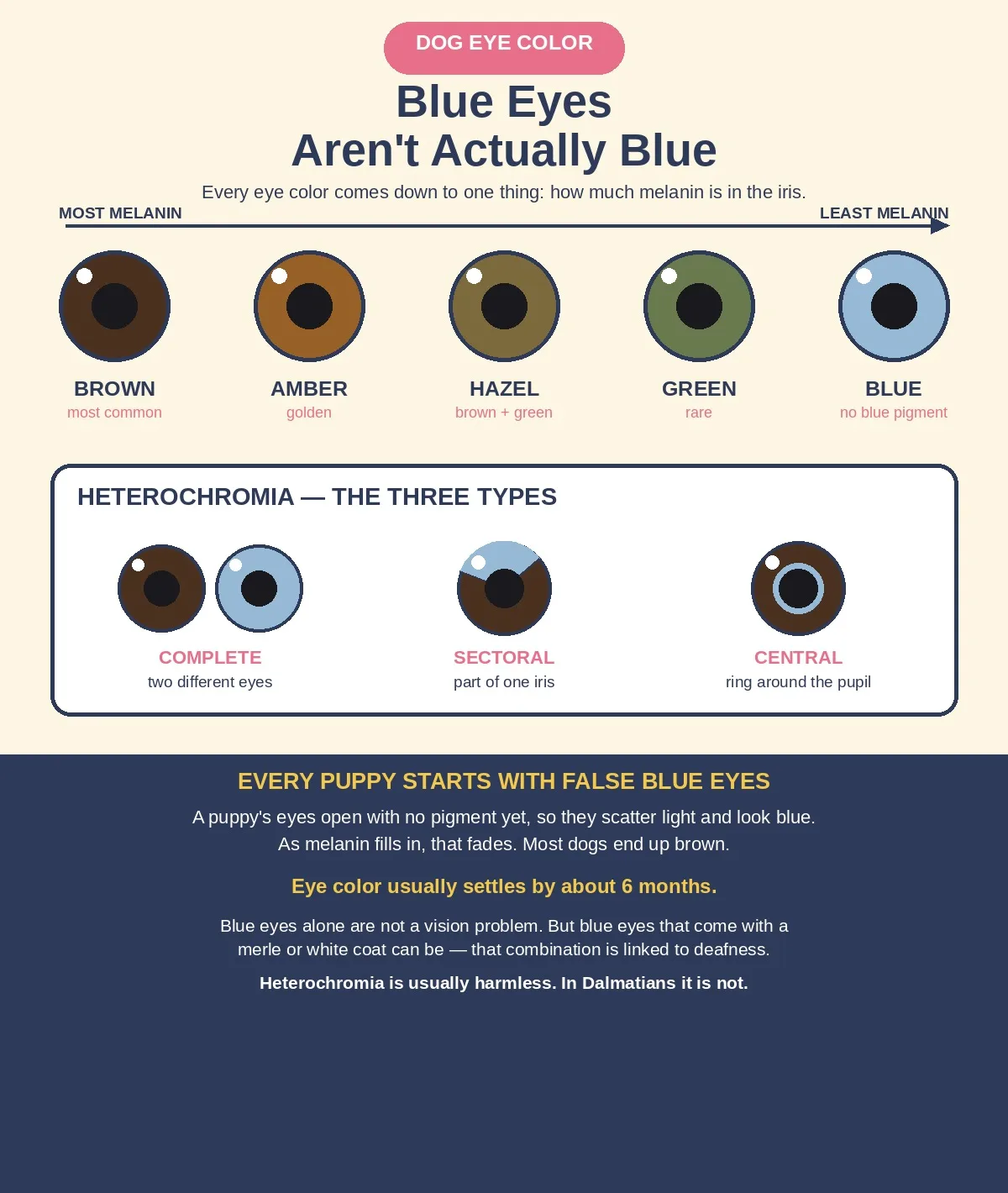
Dog eyes are not actually colored the way paint is colored. There is no blue pigment in a dog’s eye. There is not really a green pigment either. What there is, is melanin — the same pigment that colors your dog’s coat and nose — and the amount of it in the iris is what decides the eye color you see.
Brown eyes have a lot of melanin. Blue eyes have almost none. And “blue” is what you see when there is no pigment there to absorb the light: it scatters, and short wavelengths scatter more than long ones. That is the same physics that makes the sky blue. The eye is not blue. It just behaves like the sky.
This is the same reason the blue-eyed dogs of the world are not a separate category of eye — they are the low end of one continuous scale. More melanin, darker eye. Less melanin, lighter eye. Everything in between is just a point on that line.
The Range You Actually See
Brown is the most common eye color in dogs by a wide margin — everything from a light amber-brown to nearly black. If you are picturing the average dog, you are picturing brown eyes.
Amber is the golden, honey-toned eye you see in Vizslas and some herding breeds. It sits just below brown on the melanin scale.
Hazel blends brown and green, and it has a reputation for seeming to shift depending on the light. It does not actually change — it just reads differently in different lighting, which is why owners swear their dog’s eyes are a different color indoors than out.
Green is genuinely uncommon in dogs.
Blue is the striking one, and the least pigmented.
I wrote a lighter piece back in 2024 that was simply a list of the colors and the breeds that carry them — The Kaleidoscope of Canine Eyes. This post is the science underneath that one.
Why Every Puppy Has Blue Eyes
Here is the fact that tends to land hardest with new puppy owners.
Puppies are born with their eyes closed, and they stay closed for roughly the first two weeks. When they finally open, there is essentially no pigment in the iris yet. No melanin means light scatters, which means blue. So the vast majority of puppies open their eyes looking blue-eyed, no matter what breed they are or what color their eyes will eventually be.
Those are sometimes called “puppy blues,” or false blue eyes — and the distinction matters, because they are not the same as a genuinely blue-eyed dog.
Then the pigment starts arriving. As melanin fills in, the eye darkens — often passing through a greenish or golden stage on the way — and most dogs end up brown. The change typically starts around four weeks and is usually settled by about six months.
So if you have a puppy with blue eyes right now, the honest answer is that nobody can promise you anything yet. If those eyes are still a pale ice blue a few months from now, they are likely staying. If they are drifting toward gray, the pigment is on its way in.
One caution worth knowing: if your adult dog’s eyes change color after they have already settled — especially going cloudy or hazy — that is not a genetic party trick. That is a vet conversation.
Heterochromia: Three Different Things
“Odd eyes” is the phrase people use, but heterochromia is actually three distinct patterns, and they look nothing alike:
- Complete heterochromia — the two eyes are entirely different colors. One brown, one blue. This is the one people picture.
- Sectoral heterochromia — part of a single iris is a different color from the rest, like a blue slice in a brown eye. Sometimes called parti-eyed.
- Central heterochromia — the color difference is a ring around the pupil, often flaring outward in a spiked pattern rather than a clean circle.
Complete heterochromia is most often seen in Siberian Huskies, Australian Shepherds and Cattle Dogs, and Dalmatians. Sectoral and central forms show up in Border Collies, Catahoulas, Great Danes, Dachshunds, Chihuahuas, Shih Tzus, and others.
And here is the reassuring part: hereditary heterochromia is generally harmless. Dogs born with two different eye colors have normal vision. It is a cosmetic variation, not a defect.
When Blue Eyes Actually Do Matter
This is the part I want every owner to take seriously, because “blue eyes are fine” is only half the story.
Blue eyes on their own are not a health problem. But blue eyes that arrive along with certain coat patterns are a different situation entirely, because the same pigment cells that color the eye also play a role in the inner ear.
The clearest example is merle — the mottled coat on many Australian Shepherds and Catahoulas. Merle is tied to a real risk of deafness and blindness, and the risk is concentrated in dogs that inherit two copies of the merle gene. Those “double merles” usually look mostly white rather than merle, and they are the reason responsible breeders do not pair two merle dogs together.
Hereditary deafness in dogs is generally associated with white pigment and blue eyes — it shows up most commonly in Dalmatians and Australian Shepherds, but it is not limited to them.
There is also a Dalmatian-specific wrinkle worth knowing, since the breed comes up so often in conversations about spotted coats: Dalmatians with sectoral heterochromia have a higher incidence of partial or complete deafness. That is unusual. In most breeds, heterochromia carries no hearing risk at all — the Dalmatian is the documented exception.
So the accurate summary is this: blue eyes by themselves, no problem. Blue eyes plus a merle or heavily white coat, worth understanding — and worth talking to your vet about.
A Note on Huskies, Since Everyone Asks
Huskies get a reputation for mysterious, supernatural ice-blue eyes. The actual explanation is much more ordinary, and also weirder.
In a 2018 study of more than 6,000 dogs, researchers found the cause sitting on chromosome 18, near a gene called ALX4 that is involved in eye development. Blue-eyed Siberian Huskies were very likely to carry a duplicated snippet of DNA in that region. This mutation is different from the one that causes blue eyes in humans or in most other dog breeds — and different again from the merle gene.
That is why a Husky can have a dark, fully pigmented coat and still have ice-blue eyes. Merle dogs have blue eyes because the merle gene dilutes pigment everywhere. Huskies have blue eyes for their own separate reason, which does not touch the coat at all.
Curiously, plenty of brown-eyed Huskies carry the same variant. Something else — often a dark facial mask — seems to override it and push pigment into the eye anyway. Researchers have not fully worked out why. Which is a nice reminder that for all the progress, there is still plenty about dog genetics that nobody has nailed down.
What This Has to Do with Me
Eye color is not something I do anything about in the van — but I look at eyes constantly.
The reason is practical: I am checking eye health on every dog I groom, and the color is part of knowing what is normal for that specific dog. A dog’s eyes should match each other and should look clear and bright. If one eye suddenly looks different from the other, or if a settled eye color starts going cloudy, that is a change worth noticing — and it is not about color at all, it is about what the change might mean.
So I notice when your dog’s eyes look good, and I notice when they do not, and I will tell you. But whether those eyes are brown, amber, hazel, green, or the color of a winter sky is entirely up to the melanin.
Humanity over vanity — always.
New to Vroom Grooms?
If your dog needs regular grooming, the best way to get started is through the New Client Form. Use the note section for anything I should know — health conditions, behavioral quirks, coat preferences, or anything else I should be aware of before I pull into your driveway.
If you are already a current client and there is new information about your dog, text it to me directly. Anything that could affect the time or the grooming session needs to come in as soon as possible, or at least 48 hours before your appointment, in case I need to adjust my schedule or reschedule.
Ask me in person during your next appointment, or pop into my live stream on Twitch.tv/DogGroomerNIcole.
About the Author
Nicole is the owner and certified groomer behind Vroom Grooms LLC, a mobile dog grooming service serving Northwest Ohio. She specializes in double-coated breeds, anxious dogs, and clients who want honest, transparent grooming without the salon chaos. You can catch her live on Twitch at DogGroomerNIcole, where she streams real grooms and talks shop about the grooming world.
This post was drafted with help from Nagini 🐍, her digital assistant, who keeps the blog running, handles the tech side of the website, and makes sure Nicole spends more time with dogs and less time wrestling with WordPress.
Sources